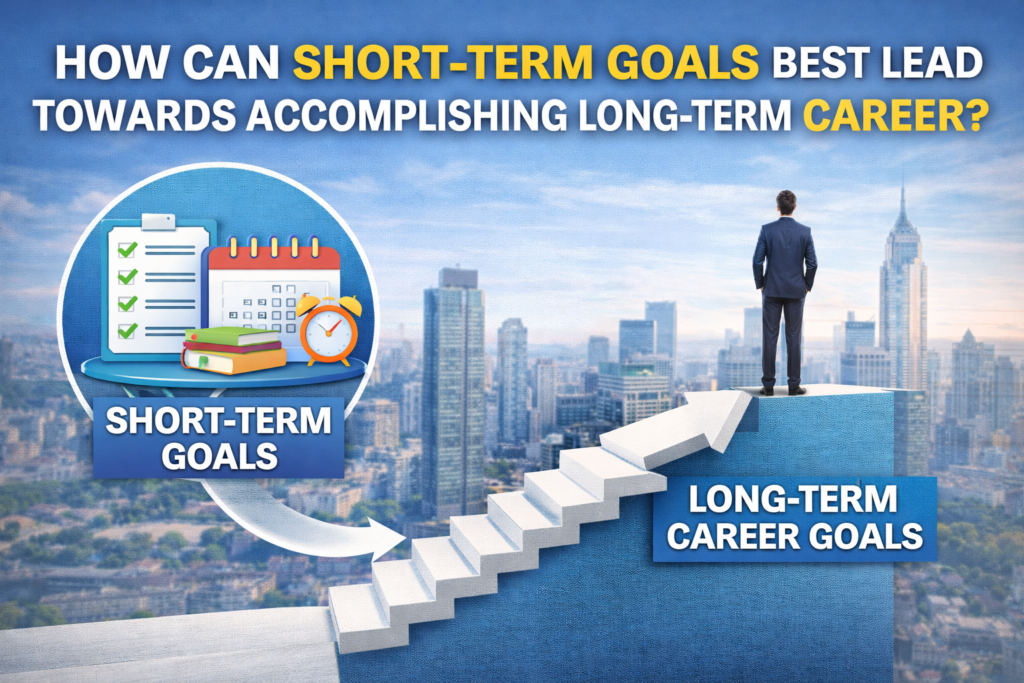
How Can Short-Term Goals Best Lead Towards Accomplishing Long-Term Career Goals? The answer is most people have a general sense of what they want their career to look like someday — a title they’re chasing, an income level they’re working toward, or maybe a specific kind of work they’d love to be doing full time. But having a vision of the future and actually getting there are two very different things, and that gap in between is where most people get stuck.
Here’s what separates people who eventually reach their long-term career goals from those who keep pushing them further and further into the future: it’s not talent, and it’s not even opportunity. Most of the time, it comes down to how they handle the short term. Understanding how short-term goals can best lead towards accomplishing long-term career goals is honestly one of the most practical things you can invest time in figuring out — because once you get this right, the whole process of building a career starts to feel a lot less overwhelming and a lot more within your control.
This article breaks it all down in a way that’s actually useful — not abstract productivity advice, but real ways to think about goal-setting that connects your day-to-day actions to the bigger picture you’re trying to build.
How Can Short-Term Goals Best Lead Towards Accomplishing Long-Term Career Goals?
Why Long-Term Goals Alone Don’t Work
Let’s start with the problem, because a lot of people skip straight to solutions without understanding why they keep falling short.
Long-term career goals are important. Wanting to become a senior software engineer, a registered nurse practitioner, a published author, or a business owner — those are real and meaningful targets. But here’s the thing about long-term goals: they live so far in the future that they don’t create any real urgency in the present. When something feels five or ten years away, it’s almost too easy to put off the work that would actually move you toward it.
Think about it this way. If someone tells themselves, “I want to be a marketing director by the time I’m 35,” that’s a clear long-term career goal. But what are they supposed to do with that on a Tuesday morning? The goal is real, but it gives them no direction for today, this week, or even this month. And so the days pass. The weeks stack up. And the goal stays exactly where it was — distant and untouched.
This is why the question of how short-term goals can best lead towards accomplishing long-term career goals is worth taking seriously. Short-term goals are the mechanism. They’re the thing that actually converts intention into action, over and over again, until one day you look up and realize you’ve closed most of the distance.
What Makes a Short-Term Career Goal Actually Useful
Not every short-term goal is created equal, and this is where a lot of people make their first mistake. They set short-term goals that feel productive but aren’t really connected to anything larger. Things like “read more books” or “network more” sound reasonable, but they’re too vague to do anything useful. They don’t create accountability, and they don’t clearly connect back to a long-term career destination.
A genuinely useful short-term goal has a few things going for it. First, it’s specific enough that you know exactly when you’ve achieved it. “Complete one online data analytics course by the end of next month” is a short-term goal. “Learn more about data” is not — it has no finish line, so it never really starts. Second, a useful short-term goal is directly traceable back to the long-term career goal it’s meant to serve. Every short-term goal should answer the question: how does this, specifically, move me closer to where I want to be? If you can’t answer that question clearly, the goal probably needs to be rethought. Third, the best short-term goals are challenging enough to push you but realistic enough that you’ll actually do them. Setting a goal that requires 30 hours a week of extra work when you have a full-time job and kids at home is not a short-term goal — it’s a recipe for burnout and disappointment.
Breaking Down the Long-Term Vision Into Phases
One of the most practical ways to understand how short-term goals best lead towards accomplishing long-term career goals is to think about your career trajectory in phases rather than as one giant leap.
Say your long-term career goal is to become an independent consultant in your field, earning a stable income from clients rather than from a single employer. That’s the five-year vision. Now work backwards. What does year three look like on that path? Maybe by then you need to have two or three paying clients, a portfolio of work, and enough industry credibility that people can find you. What does year one look like? Maybe it means staying in your current job while building a small side client base and establishing an online presence. And what does month one look like? Maybe it means updating your LinkedIn profile, identifying three people in the consulting world you could reach out to, and spending four hours researching how consulting rates actually work in your industry.
That last piece — the month-one work — is your short-term goal. It’s small, it’s doable, and it directly serves the vision. When you break a long-term career goal down this way, you’re not just hoping to eventually get there. You’re creating a staircase, and every short-term goal is one step.
This phased thinking works across almost any career path. For someone who wants to move from staff nurse to nurse practitioner, the long-term goal involves graduate school, clinical hours, and licensure. But the short-term goals along the way — researching accredited NP programs this month, scheduling a conversation with a practicing NP next week, requesting an application fee waiver for one program by a certain date — are what actually make the journey real. Without those small steps, the long-term goal just sits there, impressive but immovable.The Role of Skill-Building as a Short-Term Strategy
One of the most powerful ways that short-term goals lead towards accomplishing long-term career goals is through deliberate skill development. Almost every meaningful career goal requires you to be someone slightly different — more skilled, more knowledgeable, more experienced — than you are right now. Short-term goals are how you build that version of yourself.
The key is being intentional about which skills you’re developing and why. Randomly taking courses or picking up new tools because they sound interesting is fine as a hobby, but as a career strategy it’s scattered. What skills are most directly required for the long-term role or position you’re working toward? Start there. Talk to people who are already where you want to be and ask them what capabilities they use most. Look at job postings for the roles you’re targeting in three or five years and pay attention to what keeps coming up. Then build short-term goals around closing those specific skill gaps.
For example, someone who wants to eventually move into a leadership role in their organization might identify that public speaking and facilitation are skills they currently lack but will absolutely need. A short-term goal might be to join a local Toastmasters chapter for six months and commit to giving at least four prepared speeches during that time. That’s manageable, it’s measurable, and it directly serves the long-term career goal. Six months later, they’re not just slightly better at public speaking — they also have a concrete thing they did, which builds confidence and creates momentum.
Momentum, by the way, is something people don’t talk about enough in career planning. When you set a short-term goal and actually complete it, something happens psychologically. You prove to yourself that you’re capable of forward movement. That feeling is addictive in the best possible way — it makes the next goal easier to start, and the one after that easier still. This is one of the less obvious but very real ways that short-term goals best lead towards accomplishing long-term career goals. They don’t just add skills. They build the identity of someone who follows through.
Adjusting Without Losing Direction
Here’s something worth being honest about: long-term career goals change. Sometimes you learn more about a field and realize you want something slightly different than what you originally imagined. Sometimes life changes your priorities. Sometimes the industry shifts and the role you were targeting evolves into something new. This is normal, and it doesn’t mean short-term goal-setting has failed you — it means you’re paying attention.
The trick is learning how to adjust short-term goals without losing the thread of the larger direction. When a long-term career goal shifts, take time to reassess which of your current short-term goals still apply, which need to be modified, and which are no longer serving the updated vision. This isn’t starting over — it’s recalibrating. People who are good at long-term career planning do this regularly. They check in with their goals, assess what’s working, and make deliberate adjustments rather than either abandoning their plans entirely or blindly pushing toward a destination that no longer fits.
The short-term goal structure makes this kind of adjustment much easier than if you were just vaguely “working toward” something big. Because each short-term goal is small and specific, you can swap one out without disrupting the whole system. It’s a lot easier to change where you’re stepping next than to try to change your entire direction all at once.
Using Deadlines as a Real Tool, Not a Formality
Deadlines get a bad reputation — people associate them with pressure and stress. But when it comes to making short-term goals actually work in service of long-term career goals, a self-imposed deadline is one of the most useful tools you have.
Without a deadline, a goal is just an intention. “I want to update my resume” is something people have been meaning to do for years without ever actually doing. “I will update my resume and send it to two contacts by the 15th of this month” is a goal with a due date — and that changes the psychology of it entirely. Suddenly there’s a specific point in the future where you either did the thing or you didn’t. That accountability, even if it’s only to yourself, shifts behavior.
Set real deadlines on your short-term career goals. Put them in your calendar. Tell someone else about them if that helps you stay accountable — a friend, a mentor, a colleague who’s on a similar career journey. The act of stating a goal with a date attached to it makes it dramatically more likely to happen, and when it happens, it moves you one step closer to the long-term career outcome you’ve been building toward.
Tracking Progress Without Obsessing Over It
One underrated part of the short-term to long-term goal connection is tracking. Not obsessively — not in a way that takes more time than the actual work — but regularly enough that you have a clear sense of where you are relative to where you’re trying to go.
A simple monthly review works well for most people. Once a month, spend 20 or 30 minutes looking at the short-term goals you set for yourself. Which ones did you complete? Which ones are still in progress? Which ones didn’t happen, and why? What does that tell you about how you set up the next round of goals? This kind of regular check-in keeps your long-term career goals from drifting out of sight. It also gives you concrete information — not just feelings, but actual data about your own progress — that you can use to make smarter decisions about where to focus next.
Over time, this kind of tracking also becomes motivating in itself. When you look back at a year’s worth of short-term goals and see how many you actually completed, the connection between those small actions and your long-term career direction becomes undeniable. You can literally see the path you’ve been building.
The Mindset That Makes All of This Work
Ultimately, understanding how short-term goals can best lead towards accomplishing long-term career goals is partly a tactical question — what goals to set, how to structure them, how to track them. But it’s also a mindset question, and that part might actually matter more.
The people who use short-term goals most effectively tend to share a particular way of thinking about their careers: they see themselves as the active builders of their own path, not as people waiting to be discovered or promoted or given an opportunity. They don’t rely on one big break or one perfect moment. They trust that consistent small actions, repeated over time, add up to something real — because they’ve seen it happen in their own work, again and again.
That mindset doesn’t come naturally to everyone, but it can be developed. Every time you set a short-term career goal and follow through on it, you’re reinforcing the belief that your actions actually matter. Every time you connect a small task back to a larger vision, you’re training yourself to think like someone who is intentionally building a career rather than just having one happen to them. And that shift in identity — from passive participant to active builder — is honestly one of the most valuable things that comes out of this whole process.
Conclusion
The answer to how short-term goals can best lead towards accomplishing long-term career goals isn’t complicated, but it does require consistency and intentionality. It starts with having a real long-term vision — specific enough to mean something, flexible enough to evolve. Then it means breaking that vision down into phases, and those phases into specific, time-bound short-term goals that directly serve the bigger picture.
From there, it’s about following through. Completing those smaller goals, tracking your progress, adjusting when things change, and building the kind of momentum that makes the next step feel possible. None of this requires exceptional talent or perfect circumstances. It requires a working system and the discipline to keep using it.
Long-term career goals are worth having. But they only become real when you give yourself a clear path to walk, one short-term goal at a time.