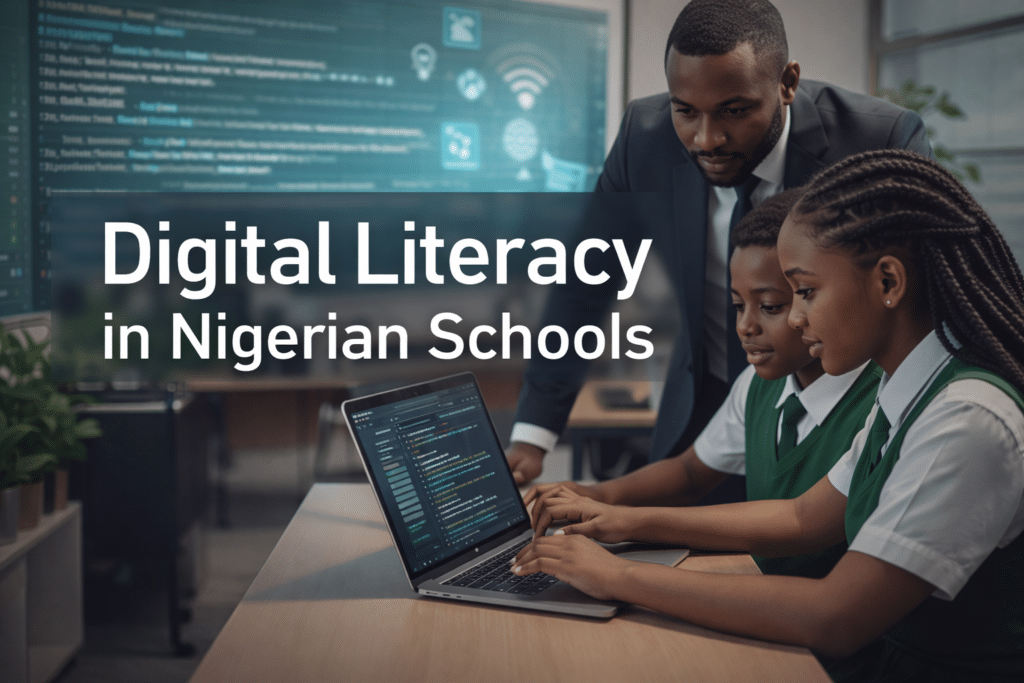
Let me ask you something straight up. Have you ever watched a bright-eyed kid in a Nigerian classroom light up when they finally understand a concept — not because the teacher explained it the old way with chalk and a blackboard, but because they clicked on a video, zoomed into a virtual diagram, or even asked an AI tool to break it down in their own language? That spark? That’s what digital literacy in Nigerian schools can deliver every single day. But right now, for far too many of our children, that moment is still out of reach.
We’re in 2026, and Nigeria is bursting with young people — over 70 million under the age of 18. The world around them is moving at lightning speed: jobs are asking for coding skills, data analysis, and the ability to tell real information from fake news. Yet walk into too many public schools and you’ll still see rows of students copying notes from a dusty blackboard while the teacher shouts over the noise of a generator. The gap isn’t just about technology. It’s about giving our kids the tools to thrive in the world that’s already here.
I’ve spent time talking to teachers, parents, and education folks across Lagos, Kano, Enugu, and some smaller towns in the Northeast. The story is the same everywhere: digital literacy in Nigerian schools isn’t a “nice-to-have” anymore. It’s the foundation our entire education system needs if we want to stop leaving millions of bright minds behind. And the beautiful part? When schools actually embrace it, the positive changes show up fast — in test scores, confidence levels, even the way kids start dreaming bigger about their futures.
In this piece, I’m going to walk you through what digital literacy really means in our context, the current state of play, and most importantly, the real, tangible ways it’s already lifting the Nigerian school system when it’s done right. No jargon, no empty promises — just honest talk about what’s working, what’s broken, and what we can actually do about it.
What Digital Literacy in Nigerian Schools Actually Looks Like
Forget the fancy definitions you see online. For a child in a Nigerian school, digital literacy is simpler than that. It’s knowing how to use a phone, tablet, or computer not just to scroll TikTok or chat with friends, but to learn, create, and solve problems.
It means a JSS2 student in Ogun State can open Google Earth and “visit” the pyramids in Egypt instead of only reading about them. It means a girl in a rural secondary school in Borno can watch a short video explaining photosynthesis in Hausa, pause it, rewind, and actually understand before the next test. It means learning how to type a proper essay, spot fake news on WhatsApp, or even build a simple presentation about local farming techniques using free tools.
Digital literacy in Nigerian schools also covers the softer skills: staying safe online, protecting personal information, and using technology respectfully. Because let’s be honest — our kids are already online. The question is whether school is helping them use it wisely or leaving them to figure it out alone.
The Reality on the Ground Today
Here’s the truth most people don’t want to say out loud: the average public school in Nigeria is still running on 20th-century methods in a 21st-century world. Power cuts, poor internet, and not enough devices mean many teachers have never even touched a smart board, let alone taught a child how to use one.
Recent checks by education bodies show that more than half of public school teachers still lack basic digital skills. In rural areas, that number climbs even higher. Kids in urban private schools might be building websites or learning coding basics, while their counterparts in government schools are lucky if they see a shared computer once a term.
But it’s not all doom and gloom. The Federal Government has started pushing hard — think UBEC’s Smart Schools programme with solar-powered classrooms, tablets for teachers, and new digital learning centres popping up in different zones. Some states like Lagos have run programmes like EKOEXCEL, putting tablets in over a thousand primary schools. The results? Teachers spend less time on admin and more time actually teaching, and kids are staying more engaged.
Still, these bright spots are the exception, not the rule. The digital divide is real, and it’s widening the gap between the haves and have-nots in our education system.
How Digital Literacy Is Quietly Transforming Nigerian Schools (When It’s Done Right)
This is the part that actually gets me excited. When schools bring digital literacy in properly, the positive ripple effects hit every corner of the education system.
First, learning outcomes jump. Take those UBEC Smart Schools that have been running for a couple of years now. Early data shows kids in Primary 3 math scoring up to 25 percentage points higher than children in nearby traditional schools. Science scores follow the same pattern. Why? Because interactive lessons let students experiment, make mistakes, and try again without fear of the whole class laughing at them. A student who struggles with fractions can watch a 90-second animation, practise on a tablet app, and actually get it before moving on.
Second, it levels the playing field in ways our old system never could. Imagine a quiet girl in a village secondary school in Cross River State who’s too shy to raise her hand in class. With digital tools, she can learn at her own pace, join an online girls-in-STEM group, and even submit assignments through a simple app. Suddenly she’s not “behind” anymore — she’s participating fully. Programmes that focus on digital literacy have already shown they help reduce the number of out-of-school children by making learning more accessible, especially for girls and kids in hard-to-reach areas.
Third, it prepares our children for real jobs. Nigeria’s youth population is our biggest asset, but only if they have skills the world wants. Digital literacy teaches critical thinking, problem-solving, and creativity — the exact things employers keep saying they need. A boy who learns basic coding in SS2 might not become the next Mark Zuckerberg, but he can build a simple website for his uncle’s business or create digital content that earns him money while still in school. That changes everything about how he sees his future.
I’ll give you a real illustration that a teacher friend in Kano shared with me. She had a class of JSS students who were bored stiff with the usual social studies textbook.
She borrowed a few tablets, showed them how to use free mapping tools, and asked them to create a digital tour of their local government area — highlighting markets, schools, and historical spots. The kids who barely spoke in class suddenly became the leaders of the group.
They researched, took photos on their phones, added voice notes in Hausa and English, and presented something they were genuinely proud of. Their engagement scores went through the roof, and their overall academic performance improved across subjects because they learned how to find and organise information themselves.
Another example comes from a small pilot in Enugu. Students used basic video editing apps to document local environmental issues — erosion, waste management, whatever affected their community. They interviewed elders, added simple graphics, and uploaded the videos. Not only did their communication skills improve dramatically, but the project also got the attention of local government officials who actually listened to the kids’ suggestions. That kind of empowerment doesn’t happen with chalk and talk alone.
On a bigger scale, digital literacy strengthens the entire Nigerian education system by making teachers more effective. Instead of spending hours copying notes, teachers can pull ready-made lesson plans, track student progress in real time, and give personalised help to kids who need it. It also opens doors to continuous training for the teachers themselves — many are now doing short online courses that fit around their busy schedules.
The economic knock-on effect is huge too. A generation that grows up digitally literate is going to drive innovation, start businesses, and compete globally. We’re talking about reducing unemployment, increasing productivity, and building a stronger middle class. That’s not hype — it’s what happens when you equip young people with the right tools.
Real Barriers We Can’t Ignore
Of course, none of this magic happens in a vacuum. The biggest hurdles are still infrastructure and training. Erratic power supply means even the best tablets become expensive paperweights half the time. Internet costs are high in many areas, and rural schools often have zero connectivity.
Teacher training is another massive gap. Many educators want to learn, but they don’t have the time or support. A lot of them are still using 2G phones that can’t run modern learning apps. And let’s not pretend money isn’t an issue — government budgets for education are stretched thin, and digital projects sometimes get treated as “extra” instead of essential.
There’s also the fear factor. Some parents and older teachers worry that too much screen time will spoil the children or push aside our culture and values. These concerns are valid and need honest conversation, not dismissal.
Practical Steps That Actually Work
So what can we do right now?
Schools don’t need to go fully digital overnight. Start small. One computer lab with solar backup and offline content can serve hundreds of students. Teachers need regular, practical training — not one-off workshops, but ongoing support where they learn alongside their colleagues.
The government is already moving in the right direction with policies like the National Digital Literacy Framework. The next step is making sure these plans actually reach the classrooms in every state, not just the big cities. Public-private partnerships have worked well in places like Lagos — telcos providing zero-rated data for education sites, tech companies donating devices, and NGOs training teachers.
Parents can play a huge role too. Even if your child’s school doesn’t have devices yet, you can encourage safe, purposeful screen time at home. Ask them to show you what they learned online instead of just handing over the phone. Communities can set up after-school digital clubs where kids share what they know.
And for the kids themselves? Once they get even a little access, most of them run with it. They’re natural digital natives — they just need guidance and opportunity.
The Road Ahead
Look, digital literacy in Nigerian schools isn’t going to solve every problem we have — poverty, inequality, you name it. But it’s one of the most powerful levers we have to create real, lasting change in our education system.
When our children can confidently navigate the digital world, they become better learners, better citizens, and better prepared for whatever the future throws at them. Test scores rise, confidence grows, creativity explodes, and the gap between rich and poor schools starts to shrink.
We’ve seen it happen in the pockets where it’s already working. Now imagine that happening in every local government area across the country. That’s not a dream — it’s a choice.
The kids in our schools today are going to run this country tomorrow. The question is simple: are we going to give them the tools they need to build something better, or are we going to keep teaching them the same way their grandparents were taught?
I know which future I’m betting on. And I hope, after reading this, you do too.