Every Nigerian university student knows the feeling—results drop, you see your grades, and then the real question hits: what is my CGPA now? You add some numbers in your head, compare them with a friend’s estimate, and still are not entirely sure if you are on track for a first class, second class upper, or somewhere below.
That uncertainty is unnecessary. Knowing how to calculate your CGPA in university is a straightforward skill that every student should have from their very first semester — not just at the end of four or five years when it is too late to course-correct.
This guide explains exactly how to calculate CGPA in university using the Nigerian grading system, walks you through worked examples from a single semester all the way to multiple years, explains what your CGPA means for your degree class, and gives you practical strategies to protect and improve it throughout your program.
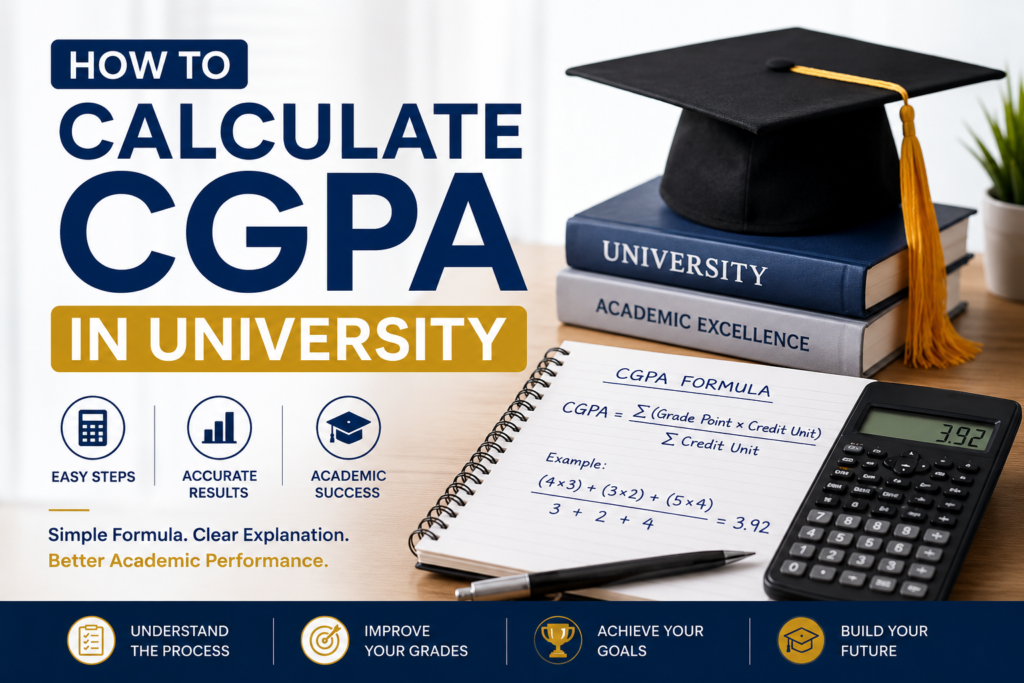
Quick Summary: To calculate your CGPA in a Nigerian university, multiply each course’s credit unit by its grade point to get quality points, add all quality points together, and then divide by the total credit units. Do this across all semesters — not just one — and divide the cumulative quality points by the cumulative credit units. Most Nigerian universities use a 5.0 grading scale. A CGPA of 4.50 and above earns a first class; 3.50–4.49 is second class upper; 2.40–3.49 is second class lower; 1.50–2.39 is third class.
What Is CGPA and Why Does It Matter?
CGPA stands for Cumulative Grade Point Average. It is the overall measure of your academic performance across every semester you have completed in university — not just the most recent one.
Your GPA (grade point average) tells you how you performed in a single semester. Your CGPA combines every semester into one cumulative figure that represents your entire academic record from the 100 level to your final year. That single number determines your degree class at graduation.
Why does it matter beyond graduation? Your CGPA affects:
- Graduate school admission—most Nigerian and international postgraduate programmes require a minimum of Second Class Upper (3.50 CGPA on a 5.0 scale) for regular admission
- Scholarship eligibility—Chevening, Commonwealth, DAAD, and most fully funded international scholarships require at least a 2:1 (Second Class Upper)
- Job applications—many Nigerian banks, FMCG companies, and multinationals specify a minimum of a second-class upper for graduate trainee applications
- Professional certifications—some professional bodies and licensing examinations use your degree class as an entry requirement
- NYSC mobilization—your CGPA and degree class appear on your NYSC call-up letter and can affect the perception of employers during NYSC
Understanding how to calculate your CGPA in university early means you can track your position at every point in your program and make deliberate decisions—about which courses to prioritize, which electives to take, and when to seek help—before it is too late to change anything.
The Nigerian University Grading System – 5.0 Scale
Most Nigerian universities use a 5.0 grading scale as directed by the National Universities Commission (NUC). Under this system, every score you receive in an examination is converted into a letter grade, which is then assigned a grade point. Here is the standard scale:
| Score (%) | Letter Grade | Grade Point (GP) | Remark |
|---|---|---|---|
| 70 – 100 | A | 5 | Excellent |
| 60 – 69 | B | 4 | Very good. |
| 50 – 59 | C | 3 | Good |
| 45 – 49 | D | 2 | Pass |
| 40 – 44 | E | 1 | Pass (Marginal) |
| 0 – 39 | F | 0 | Fail |
Important: The NUC directed all Nigerian universities in 2017 to adopt the 4.0 scale, but implementation has been inconsistent. Many universities — including UNILAG, UI, OAU, UNN, FUTA, and ABU — continue to use the 5.0 scale. Always confirm which scale your institution uses by checking your student handbook or asking your department’s examination officer. This guide uses the 5.0 scale, which is the most widely used in Nigeria.
Key Terms You Must Understand
Before calculating, make sure you understand these four terms—they are the building blocks of every CGPA calculation:
- Credit Unit (CU): A number assigned to each course that reflects how many hours per week it is taught. A 3-credit unit course meets for three hours per week. Heavier courses have more credit units and therefore carry more weight in your GPA calculation.
- Grade Point (GP): The numerical value assigned to your letter grade for a course. An A = 5, B = 4, C = 3, D = 2, E = 1, F = 0.
- Quality Points (QP): The product of multiplying a course’s Credit Unit by the Grade Point you earned in it. QP = CU × GP. This is the most important step in the calculation.
- Total Quality Points (TQP): The sum of all Quality Points across all courses in a semester (for GPA) or all semesters (for CGPA).
How to Calculate GPA for One Semester
GPA is the starting point. Before you can calculate your CGPA across multiple semesters, you need to calculate your GPA for each semester individually.
The formula is:
GPA = Total Quality Points (TQP) ÷ Total Credit Units (TCU) for that semester
Worked Example – 100 Level First Semester
Let’s say a student is in the 100-level first semester and registered for the following courses:
| Course | Credit Unit (CU) | Score (%) | Grade | Grade Point (GP) | Quality Points (CU × GP) |
|---|---|---|---|---|---|
| GST 101 | 2 | 74 | A | 5 | 10 |
| MTH 101 | 3 | 65 | B | 4 | 12 |
| ENG 101 | 3 | 55 | C | 3 | 9 |
| PHY 101 | 3 | 72 | A | 5 | 15 |
| CHM 101 | 3 | 61 | B | 4 | 12 |
| BIO 101 | 2 | 48 | D | 2 | 4 |
| TOTAL | 16 | – | – | – | 62 |
GPA = Total Quality Points ÷ Total Credit Units = 62 ÷ 16 = 3.88
This student’s GPA for the 100-level first semester is 3.88—which falls in the Second Class Upper range on a 5.0 scale.
How to Calculate CGPA Across Multiple Semesters
Your CGPA is not the average of your semester GPAs. That is a common mistake. Your CGPA is calculated by dividing the total quality points earned across all semesters by the total credit units registered across all semesters.
CGPA = Sum of All Quality Points (All Semesters) ÷ Sum of All Credit Units (All Semesters)
Worked Example – Two Semesters
Using the same student from above, let’s add their 100-level second-semester results:
| Semester | Total Quality Points (TQP) | Total Credit Units (TCU) | Semester GPA |
|---|---|---|---|
| 100L First Semester | 62 | 16 | 3.88 |
| 100L Second Semester | 54 | 18 | 3.00 |
| CUMULATIVE TOTAL | 116 | 34 | – |
CGPA = 116 ÷ 34 = 3.41
After two semesters, this student’s CGPA is 3.41—which falls in the Second Class Lower range. Notice that simply averaging the two GPAs (3.88 + 3.00 ÷ 2 = 3.44) gives a slightly different and less accurate number. The correct method always uses cumulative quality points divided by cumulative credit units.
Worked Example – Four Semesters (Two Full Years)
| Semester | Quality Points | Credit Units |
|---|---|---|
| 100L First Semester | 62 | 16 |
| 100L Second Semester | 54 | 18 |
| 200L First Semester | 70 | 18 |
| 200L Second Semester | 68 | 16 |
| TOTAL | 254 | 68 |
CGPA = 254 ÷ 68 = 3.74
After two full years, this student’s CGPA has improved to 3.74 — now comfortably in Second Class Upper territory. This improvement happened because the student performed significantly better in the 200 level than the 100 level—and the CGPA formula captured that recovery accurately.
CGPA and Degree Classification in Nigerian Universities
Your final CGPA at graduation determines your degree class. Here is the standard classification used by most Nigerian universities on the 5.0 scale:
| CGPA Range (5.0 Scale) | Degree Class | Common Name |
|---|---|---|
| 4.50 – 5.00 | First Class Honours | First Class / “First” |
| 3.50 – 4.49 | Second Class Honours (Upper Division) | 2:1 / Second Class Upper |
| 2.40 – 3.49 | Second Class Honours (Lower Division) | 2:2 / Second Class Lower |
| 1.50 – 2.39 | Third Class Honours | Third Class |
| 1.00 – 1.49 | Pass | Pass Degree |
Note: CGPA boundaries vary slightly between universities. Some institutions set their first-class threshold at 4.50, others at 4.60 or 4.70. Some universities have eliminated the Pass degree class entirely, in line with NUC guidelines. Always check your specific institution’s academic regulations for the exact thresholds that apply to your program.
How Credit Units Affect Your CGPA – The Weight Factor
One of the most important things to understand about how to calculate CGPA in university is that not all courses are equal. A 4-credit unit course affects your CGPA twice as much as a 2-credit unit course. This has a critical practical implication that many students miss.
Consider two courses in the same semester:
- Course A: 1 credit unit — you score an F (0 grade points) → Quality Points = 0
- Course B: 4 credit units — you score an F (0 grade points) → Quality Points = 0
Both are failures, but Course B does four times more damage to your CGPA than Course A. This is why failing a high-credit course like a major technical subject, laboratory, or practicum is significantly more damaging than failing a 1-unit general studies course.
The flip side is equally powerful. Scoring an A in a 4-credit unit course adds 20 quality points to your semester — more than scoring a B in four separate 1-credit courses. The smart CGPA strategy is to protect your grades in high-credit unit courses above everything else.
CGPA for Polytechnic Students – 4.0 Scale
If you are in a Nigerian polytechnic, the calculation method is the same — but the grading scale is different. Most polytechnics use a 4.0 scale regulated by the National Board of Technical Education (NBTE):
| Score (%) | Grade | Grade Point (GP) | Remark |
|---|---|---|---|
| 75 – 100 | A | 4.0 | Distinction |
| 65 – 74 | B | 3.0 | Upper Credit |
| 55 – 64 | C | 2.0 | Lower Credit |
| 45 – 54 | D | 1.0 | Pass |
| 0 – 44 | F | 0.0 | Fail |
Polytechnic degree classifications on the 4.0 scale are the following: Distinction (3.50 – 4.00), Upper Credit (3.00 – 3.49), Lower Credit (2.00 – 2.99), and Pass (1.00 – 1.99). The calculation formula — quality points divided by credit units — is identical to the university method.
How to Convert Nigerian CGPA to a 4.0 Scale
If you are applying to international universities or international scholarships, you may need to convert your Nigerian CGPA from the 5.0 scale to the 4.0 scale used in North America and many other countries. The widely accepted rough conversion is:
4.0 Scale equivalent = Your CGPA (5.0 scale) × 0.8
For example: a CGPA of 4.20 on the 5.0 scale × 0.8 = approximately 3.36 on the 4.0 scale.
However, this is a rough approximation. Most UK universities—including those accepting Chevening and Commonwealth scholarship applicants—simply use your degree class (First Class, Second Class Upper, etc.) rather than converting numbers directly. When in doubt, provide your degree class and let the receiving institution apply its own equivalency framework. You can also obtain a formal statement of comparability from UK ENIC for UK applications.
Practical Strategies to Protect and Improve Your CGPA
Understanding how to calculate your CGPA is the first step. Knowing how to protect and improve it is what actually determines your outcome at graduation.
1. Prioritise High-Credit Unit Courses
As explained above, high-credit courses have the most impact on your CGPA — positively and negatively. Identify the 3- and 4-credit unit courses in each semester and allocate proportionally more study time to them. Protecting your grade in a 4-credit course is more CGPA-efficient than acing a 1-credit course.
2. Never Carry Over a High-Credit Course
A carryover (a failed course repeated the following year) scores 0 quality points in the semester it was failed and then re-adds quality points only when retaken. The damage from a failed 3- or 4-credit course to your cumulative quality points is significant and long-lasting. Treat preventing carryovers as your highest academic priority.
3. Calculate Your CGPA After Every Semester
Do not wait until your final year to check where you stand. Calculate your CGPA after every result release. This tells you exactly how many quality points you need in the next semester to reach or maintain your target degree class—while you still have time to act on that information.
4. Know Your Target and Work Backwards
If you want a first class (4.50 CGPA), a second class upper (3.50), or any other target, you can calculate exactly what GPA you need in your remaining semesters to achieve it. This is called CGPA projection—and it is a powerful planning tool that turns abstract goals into specific semester targets.
5. Attend Lectures and Submit Continuous Assessment (CA)
Most Nigerian universities split your final grade between Continuous Assessment (CA)—typically 30 to 40%—and the end-of-semester examination—60 to 70%. CA marks come from attendance, assignments, tests, and practicals. Missing CA opportunities means entering the exam already behind, requiring a significantly higher exam score just to achieve the same letter grade.
6. Build Relationships with Lecturers Early
This is practical, not political. Lecturers who know you — who can put a face and a name to your examination paper — tend to mark more generously in borderline cases. Attend office hours, ask thoughtful questions in class, and engage genuinely with the subject matter. The marginal benefit on a borderline grade (say, the difference between 59 and 60, which is the difference between a C and a B) can meaningfully affect your CGPA over four years.
Frequently Asked Questions About How to Calculate CGPA in University
Is CGPA the same as GPA?
No, GPA is your Grade Point Average for a single semester. CGPA is your Cumulative Grade Point Average — it combines all your GPAs from every semester you have completed. Your CGPA is the figure used for degree classification at graduation.
Can my CGPA drop after a strong semester?
Yes. If a previous semester had a very high quality points contribution and your new semester performs significantly below that level, your cumulative average will pull downward. This is why maintaining consistency across all semesters — not just having one or two excellent semesters — is essential for a strong final CGPA.
What happens to my CGPA if I fail a course?
A failed course (F grade) contributes 0 quality points but still adds to your total credit units if it is a registered course. This pulls your CGPA down. When you retake and pass the course, the new grade replaces the F in your quality points—but the damage done in the semester the course was failed is factored into your cumulative calculation. This is why avoiding failures is far more effective than recovering from them.
Can I recover a low CGPA from the 100 level?
Yes—but recovery becomes progressively harder the further into your program you are. A student who scored a CGPA of 2.80 after the 100 level can realistically reach a second class upper by the final year if they score a consistent GPA above 4.00 in subsequent semesters. The key is starting the recovery early and maintaining it consistently — not relying on one or two outstanding semesters at the end.
Does my 100-level CGPA count toward my final degree class?
Yes. Every semester from the 100 level to the final year is included in your CGPA calculation. Some universities exclude 100-level results from the final classification—but this is not universal. Assume your 100-level results count unless your student handbook explicitly states otherwise.
What CGPA do I need for a first class in Nigerian universities?
Most Nigerian universities require a minimum CGPA of 4.50 on the 5.0 scale for a first-class degree. Some institutions set their threshold at 4.60 or 4.70. Check your institution’s specific regulations for the exact figure.
What is a good CGPA in Nigeria for job applications?
Most Nigerian banks, multinationals, and large companies specify a minimum of second-class upper (3.50 CGPA on the 5.0 scale) for graduate trainee applications. A first class (4.50+) opens additional doors—some companies offer accelerated tracks or higher starting salaries for first class graduates. A second-class lower (2.40–3.49) does not close all doors, but it does narrow your options at the most competitive employers.
Final Thoughts
Knowing how to calculate your CGPA in university is one of the most practically useful academic skills you can develop from your first semester. It removes guesswork, enables planning, and turns your academic journey from a series of results you react to into a progression you can actively manage.
The formula is not complicated: multiply each course’s credit units by its grade point to get quality points, add them up, divide by total credit units, and repeat across every semester. Track the number consistently. Know where you stand at every point. And when a semester goes below your target, use the calculation to determine exactly what you need in the next one to get back on track.
Your CGPA at graduation will follow you into job applications, postgraduate admissions, and scholarship competitions for years. The students who understand this early — and take deliberate action based on that understanding — consistently arrive at graduation with better outcomes than those who only check their standing in final year.
Start calculating now. There is no semester too early to know your number.