If you have been reading job descriptions in Nigeria lately, you have almost certainly seen “digital skills” listed as a requirement—sometimes at the top, sometimes tucked into the middle, but almost always there. And if you are honest, you may have nodded past it without fully understanding what it means or whether you actually have it.
That gap — between seeing the phrase and truly understanding it — is costing Nigerian graduates and young professionals job opportunities they are otherwise qualified for.
This guide answers the question directly: what are digital skills, what do they include, why do they matter so much in 2026, which specific digital skills are employers in Nigeria looking for right now, and how can you start building them—many of them for free—regardless of your educational background or course of study?
Quick Summary: Digital skills are the abilities that allow you to use technology, digital tools, and the internet effectively to complete tasks, solve problems, communicate, and contribute value at work. In 2026, 92% of jobs globally require some level of digital skills. The most in-demand digital skills in Nigeria include data analysis, digital marketing, AI tools, cybersecurity basics, content creation, and Microsoft Office proficiency. Most of these can be learned online — many for free.
What Is Digital Skills — The Full Meaning
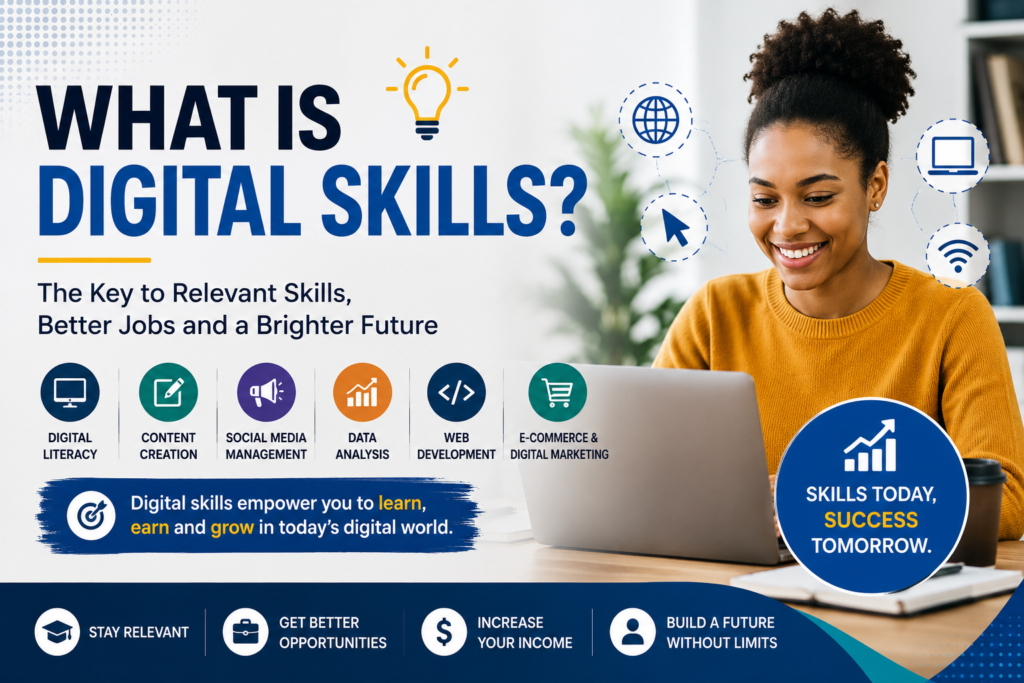
Digital skills refer to the range of abilities that allow a person to use digital devices, software applications, and the internet to perform tasks in work and daily life. They cover everything from basic computer operations and sending professional emails to advanced capabilities like data analysis, software development, digital marketing, and artificial intelligence tools.
The International Telecommunication Union (ITU) defines digital skills across three levels: foundational skills that allow everyday tasks, intermediate skills for more specific professional functions, and advanced skills for technical and specialized roles. But across all three levels, the core idea is the same — the ability to use technology effectively, responsibly, and productively.
It is important to understand one distinction that many people miss. Digital skills and digital competencies are related but not the same thing. “Digital skills” refer to specific technical abilities—knowing how to use Excel, run a Google Ads campaign, or write Python code. Digital competencies go further — they include knowing when to apply those skills, how to interpret results, and how to make sound decisions based on what technology tells you. Employers in 2026 want both.
In simple language, if you know how to use a data analytics tool, that is a skill. If you can read the output, draw meaningful conclusions, and communicate those conclusions to your team, that is competency. The most employable professionals develop both.
Why Digital Skills Matter So Much in 2026
The numbers make the case without needing much commentary.
Globally, 92% of jobs now require some level of digital skills. By 2026, IDC predicts that more than 90% of organizations worldwide will face IT skills shortages—a gap that could cost the global economy over £5.5 trillion in losses. In Nigeria specifically, the federal government’s digital technology mandate and the country’s growing digital economy mean that professionals with relevant digital skills are the primary beneficiaries of the country’s economic transformation.
Remote work — now standard across tech, marketing, and professional services — has also expanded the competition pool. A Nigerian professional with strong digital skills can now apply for and win remote roles at companies in the UK, US, Canada, and across Europe without relocating. That opportunity did not exist at this scale five years ago.
At the same time, employers are pulling back from candidates whose only asset is a degree. Companies want people who can contribute immediately. A fresh graduate who understands Google Analytics, can run a basic Facebook ad campaign, or knows how to clean data in Excel brings demonstrable value from day one. A graduate with the same degree but no practical digital skills does not — and in a tight job market, that difference is decisive.
Nigeria Context: Nigeria’s digital economy is projected to contribute significantly to GDP growth through 2030. Government programs including NITDA’s digital literacy initiative, the 3MTT (3 Million Technical Talent) program, and the Nigeria Digital Literacy Framework are all actively creating funded demand for Nigerians with digital skills—in both employment and freelancing. If you are a young Nigerian without digital skills today, that gap will cost you more each year you delay closing it.
The Three Levels of Digital Skills
Understanding where you currently sit helps you figure out what to learn next. Digital skills exist on a clear progression:
Level 1 – Foundational Digital Skills
These are the baseline abilities every working professional needs in 2026. If you cannot do these comfortably, building up to them is your first priority:
- Using a computer, smartphone, or tablet confidently
- Navigating the internet, conducting searches, and evaluating information sources
- Sending and receiving professional emails with attachments
- Using Microsoft Word, Excel, and PowerPoint (or Google Docs, Sheets, and Slides)
- Joining and participating in video calls on Zoom, Google Meet, or Microsoft Teams
- Managing files and folders across devices and cloud storage platforms like Google Drive
- Understanding basic online safety—recognizing scams, protecting passwords, and avoiding phishing
Level 2 – Intermediate Digital Skills
These are the skills that distinguish a competitive job applicant from a basic one. Employers across banking, FMCG, telecoms, NGOs, and tech companies expect at least some of these from entry-level candidates:
- Intermediate Excel or Google Sheets — formulas, pivot tables, data sorting, and basic charts
- Digital communication tools — Slack, Microsoft Teams, Trello, Asana, or Notion
- Social media management — creating content, understanding engagement metrics, scheduling posts
- Digital content creation — using Canva, basic photo editing, or video editing tools
- Email marketing basics — building a list, writing campaigns, understanding open rates
- Basic data literacy — reading dashboards, interpreting percentages, understanding KPIs
- Search engine optimisation (SEO) fundamentals—keywords, on-page optimisation, content structure
Level 3 – Advanced Digital Skills
These are specialized, high-value skills that command the highest salaries and the most competitive job offers. They typically require dedicated study or training.
- Data analysis and data science — Python, SQL, R, Power BI, Tableau
- Software and web development — HTML, CSS, JavaScript, React, and backend frameworks
- Cybersecurity — threat detection, ethical hacking, network security, compliance
- AI and machine learning — working with generative AI tools, understanding machine learning algorithms, prompt engineering
- Cloud computing—AWS, Microsoft Azure, Google Cloud platforms
- Digital advertising—running Google Ads and Meta Ads campaigns, managing budgets, optimising for ROI
- UX/UI design — user research, wireframing, prototyping with tools like Figma
The 10 Most In-Demand Digital Skills in Nigeria in 2026
Based on current employer demand across Nigerian job listings, multinational hiring patterns, and the freelance market, these are the digital skills with the highest practical value for Nigerians in 2026:
1. Data Analysis
Data is described as the new oil—and in Nigeria’s banking, fintech, FMCG, and telecoms sectors, that description is accurate. Companies collect massive volumes of data daily but need people who can interpret it and make recommendations from it. Tools like Microsoft Excel, Google Sheets, Power BI, Tableau, and Python are the most commonly required. Even basic data analysis ability—reading dashboards, identifying trends, and summarizing findings—makes you significantly more competitive in a wide range of roles.
2. Digital Marketing
Every Nigerian business with an online presence needs digital marketing skills. SEO, social media marketing, email marketing, content strategy, and paid advertising (Google Ads and Meta Ads) are in high demand from SMEs, startups, NGOs, and large corporations alike. Digital marketers who can show measurable results—traffic growth, lead generation numbers, conversion rates—are among the most consistently hired professionals in Nigeria’s current job market.
3. Microsoft Office Proficiency
Despite being the most basic entry on this list, Microsoft Office—particularly Excel—remains one of the most frequently tested and most frequently lacking skills among Nigerian fresh graduates. Advanced Excel skills including VLOOKUP, pivot tables, conditional formatting, and data validation are required for roles in banking, accounting, operations, and supply chain. Being genuinely proficient in Office separates you from a large proportion of job applicants who overstate this skill on their résumés.
4. AI Tools and Prompt Engineering
AI literacy has become one of the fastest-growing requirements in Nigerian and global job markets in 2026. Employers are not expecting graduates to build AI systems—they want people who can use generative AI tools like ChatGPT, Claude, Gemini, and Midjourney effectively to increase productivity, generate content, analyze information, and automate repetitive tasks. Understanding how to write effective prompts, evaluate AI output critically, and integrate AI tools into daily work is now a meaningful differentiator.
5. Search Engine Optimisation (SEO)
SEO is one of the most accessible high-paying digital skills for Nigerian young professionals. Every business that wants online visibility needs SEO expertise. Understanding how to conduct keyword research, structure content for search engines, build backlinks, and interpret Google Search Console data makes you immediately valuable to any company with a website. SEO freelancers in Nigeria earn between ₦100,000 and ₦500,000 per month depending on client base and experience level.
6. Cybersecurity Basics
As cyber threats increase in Nigeria—phishing attacks, data breaches, financial fraud—companies across all sectors are prioritizing cybersecurity awareness. At a foundational level, understanding how to protect passwords, identify phishing emails, recognize social engineering attacks, and handle sensitive data appropriately is now expected of every employee—not just IT staff. At an advanced level, cybersecurity professionals are among the highest-paid technical specialists in the country.
7. Content Creation
The ability to create professional digital content — written articles, social media posts, short videos, visual graphics, and presentations — is one of the most broadly applicable digital skills in Nigeria’s current economy. Tools like Canva (for design), CapCut (for video editing), and Google Docs (for writing) are accessible to anyone with a smartphone or laptop. Content creators who understand audience psychology, platform algorithms, and engagement metrics earn significantly more than those who simply produce content without strategy.
8. Social Media Management
Nigerian businesses — from small boutiques to large banks — need professionals who understand how to grow and manage an audience on Instagram, Twitter (X), LinkedIn, TikTok, and Facebook. Social media management goes beyond posting — it involves content planning, community engagement, analytics interpretation, and crisis communication. Social media managers in Nigeria earn between ₦80,000 and ₦300,000 per month depending on the client or employer.
9. Cloud Computing
Cloud platforms like Google Workspace, Microsoft 365, AWS, and Microsoft Azure are now standard infrastructure for Nigerian companies of all sizes. The ability to use cloud tools for collaboration, file management, and basic system administration is expected at the intermediate level. For IT professionals, certifications in AWS, Azure, or Google Cloud significantly increase earning potential and open doors to remote international roles.
10. Video Conferencing and Digital Collaboration
With remote and hybrid work now mainstream, the ability to communicate clearly and professionally in digital environments is a distinct skill employers evaluate. This includes managing Zoom or Google Meet sessions effectively, presenting clearly on video, using collaboration tools like Trello, Notion, or Asana for project coordination, and maintaining productivity without in-person supervision. Candidates who demonstrate these skills during the hiring process itself — through how they communicate in interviews — create a strong positive impression.
Digital Skills vs. Soft Skills — What Is the Difference?
This question comes up frequently, and it is worth addressing directly.
Digital skills are specific, learnable, tool-based abilities—knowing how to use Excel, run an ad campaign, write clean code, or analyze a dataset. They are technical. They can be tested, certified, and demonstrated through a portfolio or project.
Soft skills are interpersonal and behavioral competencies—communication, problem-solving, leadership, adaptability, and teamwork. They are harder to quantify but just as important to employers.
The most effective professionals in 2026 combine both. A data analyst who cannot communicate findings to non-technical colleagues loses much of their value. A digital marketer who cannot work within a team or meet deadlines quickly becomes a liability. Developing your digital skills alongside your communication and collaboration abilities gives you the combination that employers are actually looking for.
How to Build Digital Skills in Nigeria — Practical Starting Points
The good news about digital skills is that most of them can be learned online — and many of the best resources are free or very low cost. Here is a practical roadmap:
Free Resources to Start With
- Google Career Certificates (grow.google/intl/en_ng/): Free and paid certificate programs in data analytics, digital marketing, project management, IT support, and UX design. Widely recognized by Nigerian and international employers. The programs typically take three to six months at ten hours per week.
- Microsoft Learn (learn.microsoft.com): Free learning paths for Excel, Power BI, Azure, and Microsoft 365 tools. Certifications are available and carry significant weight in banking, consulting, and corporate roles.
- HubSpot Academy (academy.hubspot.com): Free certifications in digital marketing, content marketing, social media, email marketing, and SEO. HubSpot certificates are recognized internationally and are particularly useful for marketing roles.
- Coursera and edX: Offer free audit access to courses from universities like Harvard, MIT, and IBM. Paid certificates are available but optional—the knowledge itself is accessible for free.
- YouTube: Exceptionally useful for learning tools hands-on. Channels covering Excel, Canva, data analytics, coding, and digital marketing produce tutorial content that rivals paid courses in quality.
- Nigeria’s 3MTT Programme: The federal government’s 3 Million Technical Talent initiative provides funded digital skills training to Nigerian youth across software development, data science, cybersecurity, and AI. Check nmec.gov.ng for current enrollment opportunities.
How to Learn Faster
Learn by doing, not just watching. The biggest mistake people make when trying to build digital skills is watching tutorials passively without practicing. Open Excel while watching an Excel tutorial. Build a Canva design while following a design video. Run a small Google Ads campaign on a minimal budget while studying digital advertising. Application locks learning in ways that passive consumption never does.
Build a portfolio as you learn. A portfolio of real projects—a data analysis report, a designed social media post, a sample SEO article, a small website—is more persuasive to employers than any certificate alone. Start building one from your very first week of learning.
Focus on one skill at a time. Trying to learn five digital skills simultaneously results in shallow knowledge across all of them. Pick the one most relevant to your target career path and build genuine competence in it before moving to the next.
Frequently Asked Questions About Digital Skills
What are digital skills in simple terms?
Digital skills are the abilities that allow you to use technology, apps, and the internet effectively—whether that means sending a professional email, analyzing data in Excel, running a digital marketing campaign, or building a website. They are the technical abilities modern employers expect from everyone in the workforce, not just IT professionals.
Can I learn digital skills without a computer science background?
Absolutely. Most digital skills — including digital marketing, content creation, social media management, SEO, and data literacy — do not require any computer science or technical background. Anyone with a smartphone or laptop and access to the internet can start building these skills today. Some advanced skills like software development or data science involve more structured learning but are still accessible to non-technical people who are willing to invest the time.
What is the easiest digital skill to learn first?
For most Nigerian young professionals, digital marketing or content creation is the most accessible starting point. Both require no prior technical knowledge, the tools are mostly free (Canva, Google Analytics, and HubSpot), the learning resources are widely available, and the skills have immediate practical applications. From there, branching into SEO or social media management is a natural next step.
Do digital skills pay well in Nigeria?
Yes—and the pay increases significantly with specialization and demonstrated results. SEO specialists earn ₦100,000 to ₦500,000 per month. Data analysts earn ₦150,000 to ₦600,000 depending on their tools and experience. Software developers command ₦300,000 to ₦1,000,000 or above for senior roles. Digital skills also open the door to remote international employment, where dollar-denominated salaries are possible without leaving Nigeria.
Which digital skills are most in demand in Nigeria in 2026?
Based on current job listings and employer demand, the most in-demand digital skills in Nigeria in 2026 are data analysis, digital marketing, AI tools literacy, Microsoft Office (especially Excel), SEO, cybersecurity awareness, content creation, and social media management.
How long does it take to learn digital skills?
It depends on the skill and the depth of learning required. Foundational skills like professional email use, basic Excel, and Canva design can be developed in two to four weeks of consistent practice. Intermediate skills like digital marketing or data analysis typically take three to six months of focused study. Advanced skills like data science, software development, or cybersecurity can take one to two years to develop to a professional level.
Final Thoughts
What are digital skills in the most practical sense? It is the difference between being considered for a job and being overlooked. It is the difference between earning in naira from a local office and earning in dollars from your laptop. It is the difference between being replaced by automation and being the person who understands how to use and manage those automated tools.
In Nigeria in 2026, digital skills are not a bonus. They are a baseline. The Nigerian graduates and young professionals who recognize this early—and invest the time to build at least one or two genuine digital competencies before entering the job market—consistently outperform their peers in hiring, earning, and career progression.
The resources are available, most of them for free. The 3MTT program is funded by the federal government. Google, Microsoft, and HubSpot offer free certifications. YouTube provides hands-on tutorials for virtually every tool employers care about. The only thing separating you from a competitive digital skills profile is the decision to start and the discipline to keep going.
Start with one skill. Build it properly. Add the next one. The compounding effect of that approach, maintained over twelve months, will produce results that a passive job search alone never could.