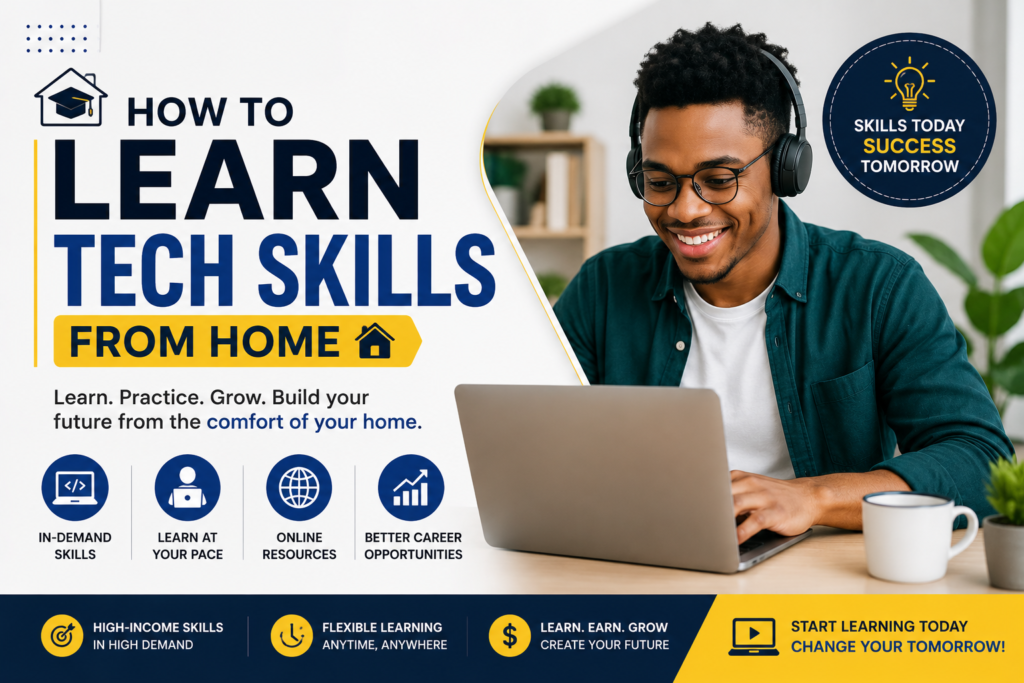
You do not need to live in Lagos. You do not need to attend a four-year computer science program. You do not even need a laptop that costs more than ₦200,000. What you need is an internet connection, a clear direction, and the discipline to show up consistently.
Learning tech skills from home has never been more accessible than it is in 2026. The same skills that land Nigerian professionals remote jobs paying in dollars — data analysis, software development, UI/UX design, cybersecurity, digital marketing — are all teachable online, mostly for free, through platforms that are fully accessible in Nigeria.
The problem is not access. The problem is that most people do not know where to start, which skill to pick first, or how to structure their learning so that it actually leads somewhere. This guide solves all of that. It walks you through exactly how to learn tech skills from home—step by step—including which skills to prioritize, which platforms to use, how to build a portfolio while you learn, and how to turn what you learn into income.
Quick Summary: The best way to learn tech skills from home is to pick one specific skill, follow a structured learning path, practice daily with real projects, and build a portfolio before you start applying for jobs or clients. Top free platforms include Google Career Certificates, Coursera, Microsoft Learn, freeCodeCamp, and Nigeria’s own Digital Skills Nigeria (DSN) and 3MTT programs. Most entry-level tech skills can be learned to a job-ready level in three to six months of consistent effort.
Why Learning Tech Skills From Home Works in 2026
The shift to remote and hybrid work has permanently changed how companies hire technical talent. A software developer in Ibadan, a data analyst in Port Harcourt, and a UI/UX designer in Enugu can all now work for companies in London, Toronto, or Amsterdam without relocating. That shift means the location where you learn your tech skills no longer determines where you can work.
At the same time, the global tech skills gap has created a window of opportunity that strongly favors self-taught learners. By 2026, IDC estimates that over 90% of organizations worldwide face IT skills shortages. Companies are not waiting for universities to produce the professionals they need — they are hiring people who can demonstrate practical skills regardless of how or where those skills were acquired.
In Nigeria specifically, government-backed initiatives like the 3 Million Technical Talent (3MTT) program and Microsoft’s Digital Skills Nigeria (DSN) initiative are actively funding free tech skills training for Nigerians aged 16 to 35. These programs did not exist five years ago. The infrastructure for learning tech skills from home in Nigeria in 2026 is the most robust it has ever been.
The graduates who take advantage of this moment will build careers that their peers who waited for formal training will spend years trying to catch up with.
Step 1 – Choose One Tech Skill and Commit to It
The most common reason people fail to learn tech skills from home is not a lack of resources. It is trying to learn too many things at once. You start with Python, then switch to web development, then pivot to digital marketing, then discover data science—and six months later you have shallow knowledge of five things and job-ready skills in none of them.
The rule is simple: pick one skill and build genuine competence in it before moving to the next.
The right skill to choose depends on three things—your interests, your current background, and your income goals. Here is a practical breakdown of the most accessible entry points:
| Tech Skill | Best For | Time to job-ready. | Earning Potential (Nigeria) |
|---|---|---|---|
| Digital Marketing / SEO | Any background | 2–3 months | ₦100,000 – ₦500,000/month |
| Data Analysis | Numbers-inclined | 3–6 months | ₦300,000 – ₦1,000,000+/month |
| UI/UX Design | Creative thinkers | 3–5 months | ₦200,000 – ₦800,000/month |
| Web Development | Logical thinkers | 6–12 months | ₦300,000 – ₦1,000,000+/month |
| Cybersecurity | Detail-oriented | 6–12 months | ₦400,000 – ₦1,200,000+/month |
| Cloud Computing | IT background helpful | 6–12 months | ₦500,000 – ₦1,500,000+/month |
| Content Creation | Communicators | 1–2 months | ₦80,000 – ₦400,000/month |
If you are completely new to tech, digital marketing or content creation are the most accessible starting points. If you are comfortable with numbers or already have a business or science background, data analysis offers the fastest path to high income. If you enjoy building things and solving logical puzzles, web development is worth the longer learning curve.
Step 2 – Use a Structured Learning Path, Not Random Videos
One of the biggest mistakes self-taught learners make is watching YouTube videos randomly without a structured progression. You watch one tutorial on Python, then a JavaScript intro, then a data visualization video, and you feel like you are learning—but you are actually just consuming content without building coherent skills.
Structured learning paths work because they take you from foundation to application in a logical sequence, each lesson building on the previous one. Here is how to get a structured learning path for free:
- Use a course with a defined curriculum. Google Career Certificates, Coursera, edX, and freeCodeCamp all offer sequenced programs with clear beginning and end points. Follow one curriculum from start to finish before jumping to another.
- Set a weekly schedule and treat it like a class. Learning from home works when it is structured like formal training. Decide which days you will study, for how many hours, and what you will cover. Vague intentions — “I will study when I have time” — produce no results.
- Finish what you start. Course-hopping is the most common failure mode in home-based tech learning. Even if a course feels slow or difficult in the middle, the completion itself is part of the discipline you are building.
Step 3 – The Best Free Platforms to Learn Tech Skills From Home
These are the most reliable, accessible, and employer-recognized platforms for learning tech skills from home in Nigeria in 2026:
Google Career Certificates
Google’s Career Certificates program is one of the most practical and employer-recognized options available to Nigerians. Offered through Coursera, the program covers data analytics, digital marketing and e-commerce, IT support, project management, UX design, and cybersecurity. Each certificate takes approximately three to six months at ten hours per week and is designed to be job-ready upon completion.
The full certificates require a Coursera subscription, but financial aid is available—and Google periodically offers free access through partnerships with African governments and organizations. Check grow.google/intl/en_ng for current free access options in Nigeria.
Best for: Data analytics, digital marketing, IT support, UX design, cybersecurity
Cost: Free (with financial aid) or approximately $49/month on Coursera
Website: grow.google/intl/en_ng
Digital Skills Nigeria (DSN) – Microsoft Initiative
Digital Skills Nigeria is a Microsoft-led initiative in partnership with the Nigerian government. It provides free access to learning resources in cloud computing, data science, AI, and Microsoft 365 tools for Nigerians aged 16 to 35. It is integrated with the 3MTT learning network and provides structured content covering everything from basic computer operations to advanced AI tools.
This is one of the most Nigeria-specific tech learning resources available, and it is completely free. If you are between 16 and 35, this should be one of your first stops.
Best for: Cloud computing, AI, Microsoft tools, data science
Cost: Free
Website: digitalskillsnigeria.org
3MTT (3 Million Technical Talent Programme)
The Nigerian federal government’s 3MTT program provides funded tech skills training across software development, data science, AI, cybersecurity, and digital marketing. The program connects learners with training providers and includes mentorship and community support. It is specifically designed for Nigerians and is one of the most significant publicly funded tech training initiatives in Africa.
Best for: All major tech skill tracks
Cost: Free (government-funded)
Website: nmec.gov.ng
freeCodeCamp (freecodecamp.org)
freeCodeCamp is one of the most respected free coding platforms in the world. It offers structured, project-based curricula in web development, data analysis with Python, machine learning, and JavaScript algorithms. Everything is completely free — no subscription, no upsell. The platform awards verifiable certificates upon completion of each curriculum, and the projects you build during the course become portfolio pieces.
Best for: Web development, Python, data analysis, JavaScript
Cost: Completely free
Website: freecodecamp.org
Microsoft Learn (learn.microsoft.com)
Microsoft Learn provides free, self-paced learning paths for Excel, Power BI, Azure cloud computing, Microsoft 365, and AI tools. Certifications through Microsoft carry significant weight in banking, consulting, and corporate Nigeria. The Azure Fundamentals (AZ-900) certification is a widely recognized starting point for cloud computing, and the learning materials are freely available.
Best for: Excel, Power BI, Azure, Microsoft 365, AI
Cost: Free learning; certification exams cost money
Website: learn.microsoft.com
Coursera and edX (Audit Mode)
Both Coursera and edX allow you to audit most courses for free — meaning you can access all the video lectures and reading materials without paying. You only pay if you want a certificate. For self-directed learners who prioritize knowledge over credentials, audit mode provides access to courses from MIT, Harvard, IBM, and Google at no cost.
Best for: Any tech skill — wide range of courses
Cost: Free (audit mode); certificates require payment
Websites: coursera.org / edx.org
HubSpot Academy (academy.hubspot.com)
HubSpot Academy is the best free platform for digital marketing, content creation, SEO, email marketing, and social media strategy. All courses and certificates are completely free, and HubSpot certificates are internationally recognized by marketing teams and agencies. If digital marketing is your chosen skill, start here.
Best for: Digital marketing, SEO, content, email, social media
Cost: Completely free
Website: academy.hubspot.com
Codecademy (codecademy.com)
Codecademy is ideal for absolute beginners to coding. Its interactive, browser-based environment lets you write and run code directly on the platform without installing anything on your computer. It covers Python, JavaScript, HTML/CSS, SQL, and more. The free plan is sufficient for learning fundamentals.
Best for: Python, JavaScript, SQL, HTML/CSS for beginners
Cost: Free (basic); paid plan for more content
Website: codecademy.com
Nigerian Local Bootcamps and Schools
Several Nigerian-based tech schools offer structured, mentor-supported training that is more suited to some learners than self-paced platforms. These include:
- AltSchool Africa (altschoolafrica.com): Structured programs in software engineering, data analysis, product design, and cybersecurity. Job placement support included. 15,000+ graduates.
- Decagon: Intensive software engineering and AI training. Selective admission but strong outcomes.
- Data Science Nigeria (DSN): AI bootcamps, mentorship, and community support focused on Nigerian learners.
- Andela Learning Community: Free community-based learning for software developers and tech professionals across Africa.
- Torilo Academy / HiiT PLC / New Horizons Nigeria: In-person and online cybersecurity, IT support, and data training with certifications.
Step 4 – Build a Portfolio While You Learn
This is the step that most home learners skip — and it is the step that determines whether your learning leads to income or just knowledge.
Employers and clients do not hire certificates. They hire people who can demonstrate what they can do. A portfolio of real projects—built during your learning process—is that demonstration.
Here is what a portfolio looks like for each major skill:
- Data Analysis: A report analyzing a real dataset (downloadable from Kaggle.com), with charts, findings, and recommendations. Present it in a PDF or on a free Notion page.
- Web Development: Two to three functioning websites — a personal portfolio site, a small business mock-up, and one project that solves a real problem. Host them for free on GitHub Pages or Netlify.
- UI/UX Design: Three to five Figma prototypes showing different design challenges — a mobile app, a web dashboard, and a redesign of an existing product. Share them via a Figma link or Behance page.
- Digital Marketing / SEO: A case study showing how you grew a real or practice website’s traffic, with before-and-after screenshots from Google Search Console or Google Analytics.
- Content Creation: A YouTube channel, TikTok page, or blog with at least ten pieces of quality content. Engagement data is your portfolio.
- Cybersecurity: Write-ups of CTF (Capture the Flag) challenges completed on platforms like TryHackMe or HackTheBox. These demonstrate hands-on security skills to hiring managers.
Start building portfolio pieces from your very first week of learning. They do not need to be perfect — they need to be real.
Step 5 – Join a Community and Stay Accountable
Learning tech skills from home in isolation is significantly harder than learning within a community. Communities provide accountability, peer support, resource sharing, and — critically — job leads and referrals.
Here are the best communities for Nigerian tech learners in 2026:
- 3MTT Learning Network: The government-backed community connected to the 3MTT program. Active across all major tech tracks.
- Andela Learning Community: Free community for African tech professionals and learners. Hosts regular events, workshops, and networking sessions.
- Data Science Nigeria (DSN) Community: Active WhatsApp and online groups for data science and AI learners. Regular bootcamps, competitions, and mentorship.
- Nigerian tech Twitter/X and LinkedIn: Following and engaging with Nigerian tech professionals on these platforms puts you in contact with people who share opportunities, referrals, and industry insights daily.
- Slack communities: Many Nigerian tech communities operate on Slack. Techpoint Africa and She Code Africa maintain active communities worth joining.
Step 6 – Get Certified and Start Applying
Certifications matter — but they are not a substitute for demonstrated skill. The right order is learning the skill, building the portfolio, and then getting certified. Certification confirms what your portfolio already shows.
The most recognized entry-level certifications for Nigerian tech learners in 2026:
- Google Data Analytics Certificate — for data analysis roles
- Google Digital Marketing and E-commerce Certificate — for marketing roles
- HubSpot Content Marketing / SEO Certification — for content and marketing roles
- Microsoft Azure Fundamentals (AZ-900) — for cloud and IT roles
- CompTIA Security+ — for cybersecurity roles
- AWS Certified Cloud Practitioner — for cloud roles. Study materials are free via AWS Skill Builder.
- Meta Blueprint Certification — for social media advertising and digital marketing roles
Once you have your portfolio and at least one relevant certification, you are ready to start applying for jobs on Jobberman, LinkedIn, and HotNigerianJobs, and for freelance clients on Fiverr, Upwork, and Toptal.
Common Mistakes to Avoid When Learning Tech Skills From Home
- Tutorial hell. Watching tutorial after tutorial without building anything yourself. After every tutorial, close the video and reproduce what you just watched from memory. That is how skills solidify.
- Switching skills before achieving depth. Deciding that data analysis is “too hard” after two weeks and switching to web development — then switching again after three weeks — is one of the most common and most damaging patterns in self-directed tech learning.
- Collecting certificates without skills. A certificate from a course you did not properly engage with will not survive a technical interview or a client project. Focus on genuine competence — the certificate should reflect real ability, not just completion.
- Not practicing on real data or real problems. Textbook exercises and toy datasets have their place, but nothing builds practical skill faster than working on real-world problems. Download actual data from Kaggle, build a website for a real local business, or run a real digital marketing campaign on a small budget.
- Waiting to be “ready” before applying. Many self-taught learners delay applications because they feel they do not know enough. In reality, most entry-level tech roles expect to train new hires—what they want is demonstrated potential, a solid portfolio, and the right attitude. Start applying earlier than feels comfortable.
- Learning without internet access management. Erratic internet is a real challenge for Nigerian learners. Download course videos for offline viewing wherever possible, use mobile data bundles efficiently, and schedule your most intensive learning during off-peak network hours.
How Long Does It Take to Learn Tech Skills From Home?
The honest answer depends on the skill, your daily commitment, and the quality of your learning approach. Here is a realistic timeline for each major skill track, based on one to two hours of focused study per day:
- Digital Marketing / SEO: Two to three months to job-ready fundamentals. Six months to a strong, monetizable skill level.
- Content Creation and Social Media Management: One to two months to a basic level. Three to four months to a professional portfolio standard.
- Data Analysis (Excel, SQL, Power BI): Three to four months to become job-ready. Six months with Python added.
- UI/UX Design: Three to five months to a portfolio-ready level using Figma.
- Web Development (HTML, CSS, JavaScript): Six to nine months to build functional websites. Twelve months to a full-stack, employable level.
- Cybersecurity: Six to twelve months to CompTIA Security+ certification level and entry-level job readiness.
- Cloud Computing: Six to twelve months to AWS or Azure Fundamentals certification and entry-level cloud roles.
These timelines assume consistent daily learning and active project-building alongside the courses. People who only watch videos without practicing take significantly longer—or never reach a job-ready level at all.
Frequently Asked Questions About How To Learn Tech Skills From Home
Can I learn tech skills from home without a laptop?
Yes — to a point. Smartphones can support learning through apps and mobile-optimized course platforms. However, practical skills like coding, data analysis, and UI/UX design are significantly harder to develop without a keyboard and a larger screen. A basic laptop is a meaningful investment for anyone serious about building a tech career. If cost is a barrier, look into the 3MTT program and AltSchool Africa—some structured programs provide device access as part of enrollment.
Which tech skill is easiest to learn from home as a beginner?
Digital marketing and content creation are the most accessible starting points — they require no technical prerequisites, the tools are free or low-cost, and the learning resources are abundant. From there, SEO and social media management are natural next steps. For those comfortable with numbers, data analysis using Excel is another accessible entry point.
Are free tech courses good enough to get a job?
Yes—especially Google Career Certificates, HubSpot Academy certifications, freeCodeCamp curricula, and the 3MTT program. What matters more than where you learned is what you can demonstrate. A strong portfolio built through free courses consistently outperforms a paid certificate with no practical application behind it.
How do I stay motivated learning tech skills from home?
Set a specific goal—not “I want to learn coding” but “I will build a functioning portfolio website by the end of month three.” Join a community so you have people to learn alongside. Track your progress visibly—a simple checklist of completed modules motivates continued effort. And apply what you learn to real projects as soon as possible — seeing your skills produce something real is the most powerful motivator there is.
Can I freelance while still learning tech skills?
Yes — and you should. Many tech learners wait until they feel “fully skilled” before offering their services. In reality, you can start taking on small freelance projects once you have two to three months of focused learning behind you. Small clients—local businesses, NGOs, school friends—are forgiving of imperfection and provide the real-world practice that accelerates your skill development faster than any course alone.
Final Thoughts
Learning tech skills from home in Nigeria in 2026 is not a backup plan. For thousands of young Nigerians, it has become the primary path to income, career growth, and access to the global economy — all from a single room with a laptop and a mobile data connection.
The resources are there. The government is funding access through 3MTT. Microsoft is providing free training through Digital Skills Nigeria. Google, HubSpot, freeCodeCamp, and Coursera are making world-class curricula available at zero cost. The gap between where you are and where you want to be has never been smaller.
What closes that gap is not more resources. It is the decision to start today, with the skill you have chosen, and the discipline to keep going when the learning feels hard. Most people who start do not finish. The ones who finish are the ones who build careers.
Pick your skill. Open the first resource. Begin.
Sources & References
Online learning and tech education research:
[1] Coursera. “2026 Global Skills Index – Tech Skills in Demand.” Retrieved from: https://www.coursera.org/
[2] Udacity. “State of Tech Education 2026 Report.” Retrieved from: https://www.udacity.com/
[3] LinkedIn. “Most In-Demand Tech Skills 2026.” Retrieved from: https://business.linkedin.com/talent-solutions/
[4] Glassdoor. “Best Online Tech Learning Platforms 2026.” Retrieved from: https://www.glassdoor.com/research/
[5] Stack Overflow. “Developer Survey 2025 – Learning Methods.” Retrieved from: https://survey.stackoverflow.co/