Cover Letter Writing Tips That Actually Get You Hired
Most cover letters don’t get read. That’s the uncomfortable truth that most articles about cover letters skip over. Recruiters receive dozens, sometimes hundreds of applications for a single position, and the vast majority of cover letters say the same things in the same way: “I am writing to express my interest in this position,” “I believe I would be a great fit,” “I am a hardworking and dedicated individual.”
Nobody reads past the second sentence of a letter that opens like that.
This guide is about cover letter writing tip that a recruiter actually finishes reading — one that makes them feel, by the end of the first paragraph, that they want to meet you. That’s the only standard that matters.
What a Cover Letter Is Actually For
Before tips, it helps to understand the purpose of the document. A cover letter is not a summary of your CV. It’s not a list of your qualifications. It’s not a formal declaration that you want a job.
A cover letter is a short, direct argument for why a specific employer should give you a specific opportunity. That word “specific” is doing a lot of work. A cover letter that could be sent to any company for any job is, effectively, useless.
The best cover letters show that you understand the company, that you’ve thought about what the role needs, and that your experience connects to those needs in concrete ways. They also give the reader a sense of who you are as a person — something a CV, which is inherently impersonal, cannot do.
Start With Something That Makes Them Keep Reading
Your opening line is not the place for formality. Consider the difference between these two openings:
“I am writing to apply for the Marketing Manager position advertised on your website.”
versus
“When I saw your Q3 campaign for the Lagos expansion, I had three ideas before I’d finished reading it — which probably says more about why I’d enjoy this role than anything on my CV.”
The first tells the recruiter nothing they don’t already know. The second creates immediate curiosity and establishes something specific about you: you think proactively, you pay attention to the company’s work, and you’re confident without being arrogant.
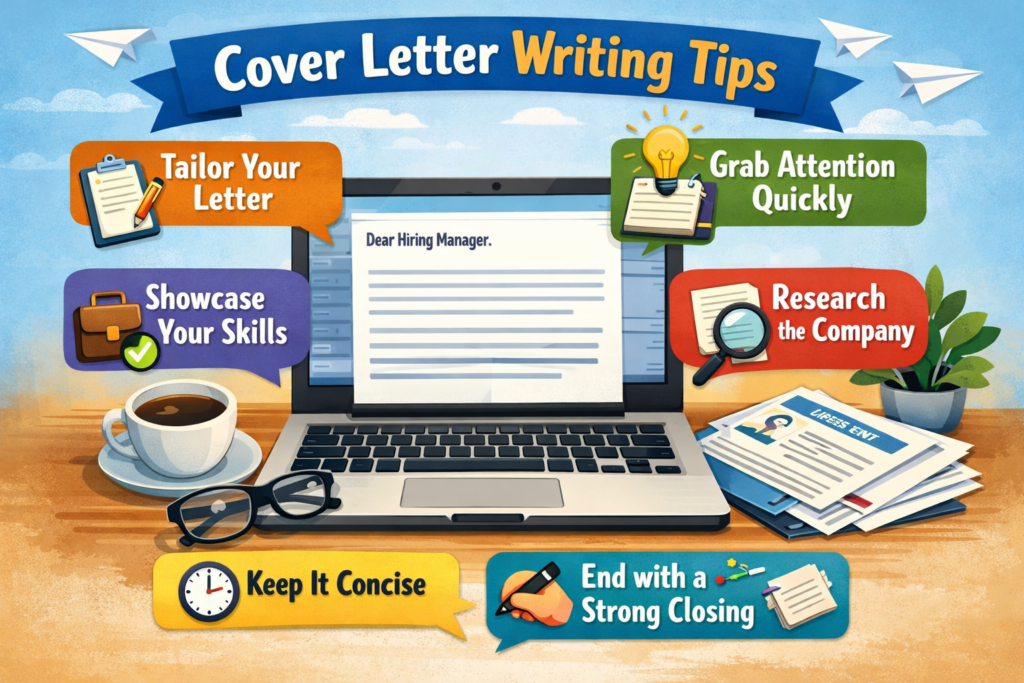
Your opening doesn’t have to be as flashy as that example. But it has to be something the recruiter hasn’t read before. Lead with a specific observation, a genuine reaction to something the company does, or a single compelling fact about your experience that directly relates to what they’re hiring for.
Make the Body About Their Problem, Not Your History
This is where most cover letters fall apart. The body of the letter becomes a verbal version of the CV — “I worked at X company for two years where I did Y” — when it should be addressing something entirely different: what does this employer need, and why are you the person who can deliver it?
Read the job description carefully. What does it ask for? What problems is this role designed to solve? What would success look like for someone in this position six months from now?
Then write about yourself in direct relation to those things. If the role requires project management experience and you’ve managed projects, don’t just say “I have project management experience.” Say what kind, say what the challenge was, say what you did, and say what the result was. One specific example told briefly will do more work than four vague claims.
A useful formula: situation, action, result. What was the context, what did you specifically do, and what happened as a direct consequence. That structure keeps your writing grounded and concrete, which is what busy recruiters appreciate.
Show You’ve Done Your Research
Nothing signals effort and genuine interest more clearly than showing you know something about the company that isn’t on the first page of their website.
This doesn’t require hours of investigation. Read their most recent press coverage. Look at their social media posts from the last few months. Check if they’ve launched a new product or entered a new market. If you can mention something specific — a challenge they’re facing, a direction they’re moving in, something they’ve said about their values — and connect it to why you’re applying, you immediately separate yourself from the majority of applicants who wrote their cover letter without ever looking at the company’s actual work.
Even something as simple as “I’ve been following how your team has approached the challenge of reaching younger demographics in your content strategy” shows that you paid attention. Recruiters notice this.
Don’t Explain Weaknesses Unless Asked
A common mistake is using the cover letter to pre-emptively apologise for gaps or shortcomings. “Although I don’t have direct experience in…” or “While I may not have the exact background you’re looking for…” immediately draws attention to what’s missing.
A cover letter is a pitch, not a confession. Your job is to build the strongest possible case for what you do bring to the role. If there’s a genuine gap that the employer is likely to see and ask about, you can briefly acknowledge it and pivot to what you offer instead — but keep it very brief and end on your strength, not your limitation.
Close With Confidence, Not Desperation
The way most cover letters close: “I hope you will consider my application,” “I look forward to hopefully hearing from you,” “I would be grateful for the opportunity to discuss this further.”
The energy in those closings is apologetic. You’re essentially asking for permission to be considered, which communicates low confidence.
A stronger closing is direct and forward-looking: “I’d welcome the chance to discuss how my background in X aligns with what you’re building at Y. I’ll be available for a conversation at your convenience.” Or simply: “I’m excited by the direction your team is heading and I’d be glad to show you more specifically how my experience fits into it.”
You don’t need to be aggressive. You need to close with the same energy someone has when they genuinely believe they can do the job well. That tone — confident, specific, calm — is what leaves a good impression.
Format and Length: Keep It Tight
A cover letter should fit on one page. Not because there’s a rigid rule, but because if you can’t make your argument in roughly 300–400 words, you probably haven’t thought clearly enough about what you’re actually trying to say.
Use clean, professional formatting. No unusual fonts. No coloured text. A reasonable font size — 11 or 12 points. Margins that give the page some breathing room. Leave white space between paragraphs.
If you’re sending by email rather than through a formal application portal, the cover letter can be the email body itself. In that case, shorter is better — three focused paragraphs are more likely to be read in full than a formatted five-paragraph document attached to an email.
The Tailoring Rule: Write a Fresh One for Every Application
This is time-consuming, and that’s exactly why it works. Most candidates apply to twenty jobs with the same cover letter and wonder why they get no response. A cover letter that was clearly written for this specific company and this specific role creates an immediate positive impression.
You don’t have to write from scratch every time. Keep a master version of your cover letter that covers your strongest points generally. Then for each application, customise the opening, add the specific company detail, and adjust the middle section to match the most relevant parts of the job description. That process takes fifteen to twenty minutes per application, which is a reasonable investment for a job you actually want.
Common Cover Letter Mistakes That Kill Applications
Repeating the CV. If your cover letter says the same things as your CV, it adds nothing. The employer already has your CV. Use the cover letter to say something the CV doesn’t.
Generic opening lines. “I am writing to express my interest in…” is the fastest way to get your letter skimmed rather than read.
Focusing entirely on what you want from the job rather than what you offer. “This role would allow me to develop my skills in…” reads as self-interested. Focus on what you bring.
Exceeding one page. If a recruiter has to scroll or turn a page, you’ve already made the job harder than it should be.
Spelling and grammar errors. Have someone read it before you send it, or run it through a grammar checker. Errors signal carelessness, which is a specific signal you don’t want to send to someone who is deciding whether to trust you with a job.
Using exaggerated praise about the company. “I have always admired your amazing company” reads as flattery, not research. Specific observations are far more convincing than superlatives.
A Sample Structure That Works
Paragraph 1 (2–3 sentences): A strong opening that’s specific to this role or company. Something that signals you’ve thought about this application, not just submitted it.
Paragraph 2 (4–6 sentences): Your strongest relevant experience, framed around what the employer needs. Use the situation-action-result format. Keep it concrete.
Paragraph 3 (2–3 sentences): A brief bridge connecting your interest in the role to something specific about the company’s direction or values.
Paragraph 4 (1–2 sentences): A confident, forward-looking close.
That structure in 300–400 words will outperform most cover letters in any application pool.
Frequently Asked Questions About Cover letter Writing Tips
Do employers actually read cover letters?
It depends on the employer and the role. Some recruiters read every letter carefully; others skip them entirely. Writing a strong one means you’re covered either way — if it gets read, it works in your favour, and if it doesn’t, your CV stands on its own.
Should I send a cover letter if the job listing says it’s optional?
Yes. “Optional” in job listings usually means the hiring team will read it if you include it, and the fact that you did signals genuine interest. Most strong candidates include one.
How long should a cover letter be?
Between 250 and 400 words for most applications. Long enough to make a proper argument; short enough to respect the recruiter’s time.
What if I have no experience for the role?
Focus on transferable skills — things you’ve done in academic, volunteer, or personal contexts that demonstrate the capabilities the role requires. Be honest about your level and confident about your potential. Employers hire entry-level candidates all the time; what they’re looking for is evidence of the right foundation.
Should I use the same cover letter for every job?
No. Tailor each one. At minimum, change the opening, reference something specific about the company, and adjust the middle section to match the specific role’s requirements.