
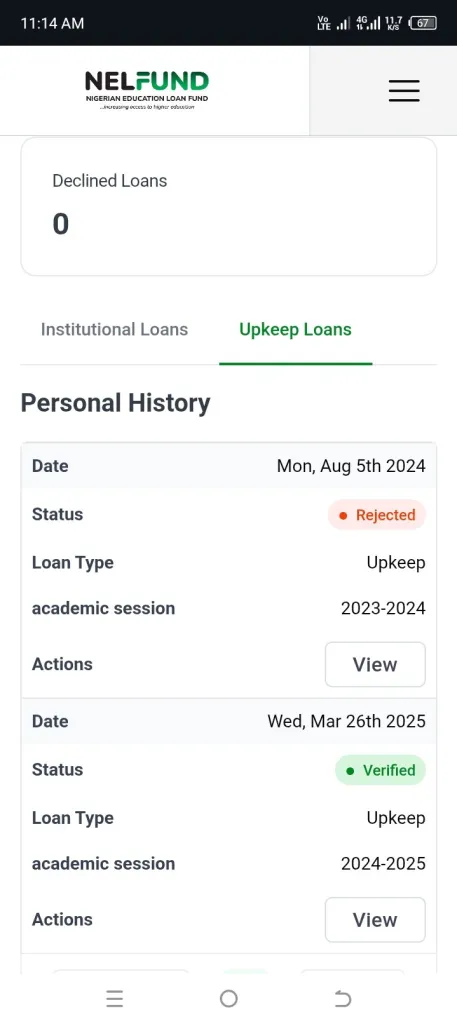
A NELFUND application rejected notice—or worse, a sudden “Rejected” status after months of successful payments—is one of the most stressful things a Nigerian student can see on their dashboard. Unlike a lot of scholarship guidance built on guesswork, NELFUND has actually published its official rejection reasons directly, which means we can go through each one with real accuracy instead of speculation.
Since launching, the Nigerian Education Loan Fund has disbursed well over ₦180 billion to more than 1.5 million students, and the loan itself is interest-free, with repayment beginning two years after NYSC. But the application and disbursement process has real, documented friction points—here’s every one of them and exactly how to fix it.
First: rejected and pending are not the same thing.
Before anything else, it’s worth separating these two, because they get confused constantly. A pending status does not mean your application has been rejected—it usually means your loan is still within the verification or processing stage, most commonly waiting on your institution to confirm your enrollment and tuition details with NELFUND. This is a normal part of the process, not a red flag. An actual NELFUND application rejected status is different—it comes with a specific reason shown directly on your dashboard, and it means something specific needs correcting before you can proceed.
Reason 1: Incomplete or unclear documentation
What it means: at the initial application stage, missing pages, blurry uploads, or documents that don’t clearly show the required information can trigger a rejection before your application is even fully assessed.
How to avoid it: review every uploaded document for clarity and completeness before final submission—a scanned or photographed document that looks fine on your phone screen can still be rejected if it’s not fully legible at full size, so check each file individually rather than trusting a quick glance.
Reason 2: Incorrect bank account details
What it means: if the bank account details you provide don’t match official records or contain an error, this is flagged as a specific rejection reason at the initial stage.
How to avoid it: double-check your account number and bank name against your actual account details rather than typing from memory, and confirm your account is active and correctly linked to your BVN, since mismatches here are a common and entirely avoidable cause.
Reason 3: Name mismatch across your documents
What it means: this is one of the most common and most avoidable reasons—your name needs to appear exactly the same across your NIN, your JAMB profile, and your school records. Even a small difference (a missing middle name, different capitalization, or a different name order) can trigger a mismatch.
How to avoid it: before applying, compare your name as it appears on all three sources side by side. If you find a discrepancy, correct it at the source (NIMC for your NIN, JAMB for your JAMB profile, or your school’s registry for institutional records) before applying, rather than after a rejection—fixing it retroactively after a rejected application takes longer than getting it right the first time.
Reason 4: Institutional verification not completed or declined
What it means: before funds are released, your institution must verify your student status and confirm your tuition details with NELFUND. If your school hasn’t completed this step—or in rarer cases, has declined to approve your details for their own internal reasons—your application can’t move forward. This is described as often the biggest bottleneck in the entire process, and it’s outside your direct control.
How to avoid it: contact your school’s bursary or registry office directly to confirm they’ve completed their verification step on their end. This isn’t something you can fix from your own dashboard—it requires your institution to act, so a direct follow-up with them is more effective than repeatedly checking your own application status.
Reason 5: Applying for upkeep in a session that’s already closed
What it means: upkeep disbursements are now strictly tied to your institution’s specific academic session. If you apply for upkeep for a session that has already ended, this triggers an automatic rejection at the upkeep application stage specifically—separate from your main loan approval.
How to avoid it: confirm your institution’s current academic session dates before submitting an upkeep application, and reapply promptly once a new session begins rather than assuming a previous approval carries forward automatically.
Reason 6: False or inconsistent declarations
What it means: this is the most serious category. Where any declaration made during application is found to be false, the applicant is immediately disqualified from the scheme, and any loan already granted can be affected.
How to avoid it: this one has a simple fix—accuracy. Don’t estimate, guess, or exaggerate any detail on your application, even ones that seem minor. Every field should reflect your actual documented status.
A newer complication: sudden “Rejected” status after months of successful payments
This is a genuinely unusual issue that’s affected a real number of students, particularly early beneficiaries—a NELFUND application rejected notice appearing suddenly on a dashboard despite the student having received several months of consistent disbursements already. Reported cases have traced this back to specific technical causes, including students using digital-only banking platforms rather than conventional banks, which NELFUND later addressed by resuming disbursements for affected students who updated to conventional bank accounts.
What to do if this happens to you: update your bank details to a conventional bank account through the portal if you’re currently using a digital-only banking platform, and reach out through NELFUND’s official communication channels for clarification on your specific case rather than assuming the loan has been permanently withdrawn.
Quick reference: NELFUND rejection reasons and fixes
| Rejection reason | Stage it occurs. | Fix |
|---|---|---|
| Incomplete or unclear documents | Initial application | Re-upload clear, complete, legible documents. |
| Incorrect bank details | Initial application | Verify the account number and bank name match your records exactly. |
| Name mismatch across documents | Initial application | Align your name across NIN, JAMB, and school records before reapplying. |
| The institution hasn’t verified you. | Institutional verification | Follow up directly with your school’s bursary/registry. |
| Applying for a closed session | Upkeep application | Confirm current session dates before applying. |
| False declaration | Any stage | No fix—accuracy from the start is the only prevention. |
| Sudden rejection after prior payments | Post-disbursement | Switch to a conventional bank account; contact NELFUND directly. |
What to do after a rejection
NELFUND has stated that students can reapply once the specific issue behind a rejection is resolved—a rejection isn’t necessarily permanent. All rejection reasons are shown directly on your applicant dashboard, so start there rather than guessing which of the reasons above applies to your specific case.
FAQ
Does an NELFUND application rejected status mean I can never get the loan? No—NELFUND has confirmed students can reapply once the specific issue causing the rejection is resolved. Check your dashboard for the exact stated reason rather than assuming it’s final.
My status just says “pending”—is that the same as “rejected”? No. Pending means your application is still in verification or processing, most often waiting on your institution to confirm your details. This is normal and not something to be alarmed about on its own.
How do I know if the problem is on my end or my school’s end? Institutional verification delays are one of the most common bottlenecks and are entirely on your school’s side—if your documents, bank details, and name consistency all check out and you’re still stuck, contact your school’s bursary or registry directly to confirm they’ve completed their verification step.
I was receiving upkeep for months, and it suddenly stopped with a rejected status—what happened? This has affected a real number of students, and in reported cases it’s been linked to using a digital-only banking platform rather than a conventional bank account. Update your bank details through the portal and contact NELFUND’s official channels for your specific case.
Can I fix a name mismatch after I’ve already applied, or do I need to start over? You can generally correct the underlying record (at NIMC, JAMB, or your institution, depending on where the mismatch originates) and then reapply—but resolving it before your first application saves significant time compared to fixing it after a rejection.