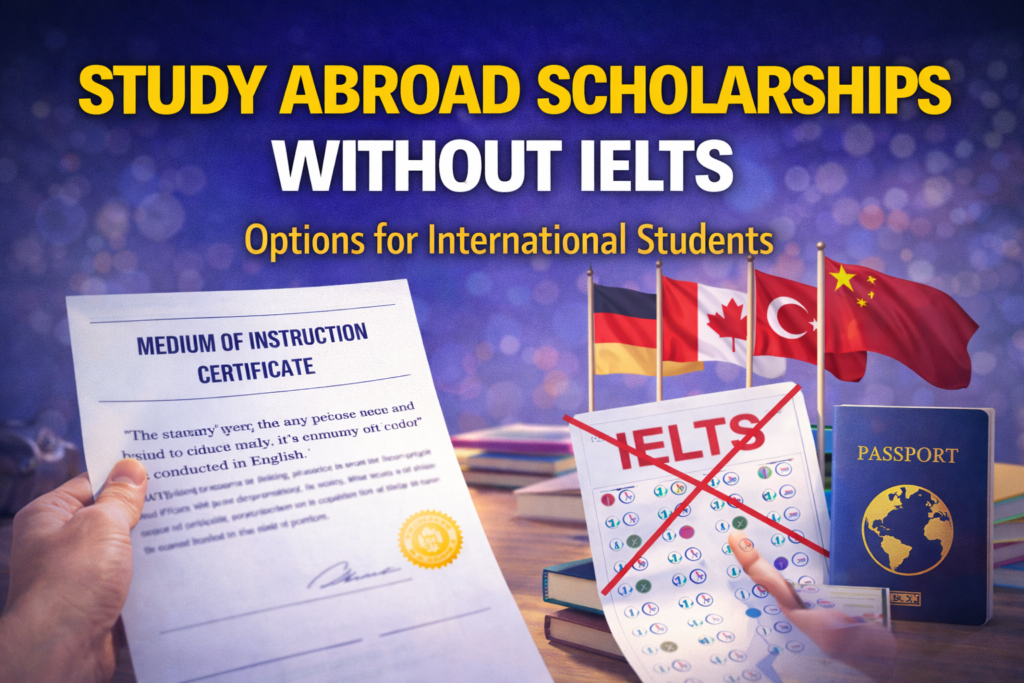
Do you know you can get a scholarship without IELTS? For many students who dream about studying abroad, one small requirement can suddenly feel like a giant wall.
You’ve probably heard of it already. The International English Language Testing System is one of the most common language exams universities require. And honestly, preparing for it can take months. The exam itself isn’t cheap either.
But here’s something a lot of students don’t realize at first.
Not every scholarship or university requires IELTS.
Yes, really.
Every year thousands of international students study in countries like Germany, Canada, Turkey, and even the United States without submitting an IELTS score. Some universities accept alternative proof of English ability. Others simply waive the requirement if you studied in English before.
So if IELTS has been the one thing slowing down your study abroad plans, you might have more options than you think.
Let’s walk through how these scholarships work, where to find them, and how students actually get approved without taking the IELTS exam.
Why Some Universities Allow Scholarships Without IELTS
At first, it sounds surprising.
Why would universities remove such a common requirement?
Well, there are a few reasons.
First, universities understand that many international students have already studied in English during high school or college. In those cases, forcing them to take another English exam doesn’t always make sense.
Second, schools want to attract talented students from different parts of the world. Strict testing rules can discourage strong applicants who simply don’t have easy access to testing centers.
And finally — this surprises many people — universities often conduct their own interviews or internal language assessments.
In other words, they may evaluate your English in different ways.
So instead of a test score, they might accept something called a Medium of Instruction certificate, often shortened to MOI.
The Medium of Instruction (MOI) Alternative
Let’s talk about the MOI certificate because it’s one of the most common ways students skip IELTS.
A medium of instruction letter is a simple document from your school that confirms your previous education was taught in English.
That’s it.
If your high school or university taught courses in English, the administration can usually issue this letter.
Many universities accept this document instead of IELTS. It tells them you’ve already been learning in English, so they can reasonably expect you to handle lectures and coursework.
Some institutions may still conduct a short interview to confirm your language ability. But compared to preparing for a full IELTS exam, it’s a much easier path.
Countries That Offer Scholarships Without IELTS
Here’s where things get interesting.
Several countries are known for offering scholarships or admission routes without IELTS.
Not every university participates, of course. But there are plenty that do.
Let’s look at a few popular destinations.
Germany
Germany has quietly become one of the most attractive study destinations for international students.
Public universities often charge very low tuition—sometimes no tuition at all.
And yes, many German universities allow international applicants to apply without IELTS if they provide a medium of instruction letter or pass a university language interview.
Scholarships like the DAAD scholarship program sometimes accept alternative language proof depending on the program.
Students from around the world apply every year.
Turkey
Turkey is another country many students overlook.
The Türkiye Scholarships program is a government-funded opportunity that covers tuition, accommodation, health insurance, and even a monthly stipend.
And here’s the key part.
In many cases, IELTS is not required. The scholarship committee may assess your English during interviews instead.
This makes the program particularly appealing for students who want full financial support without standardized testing.
Canada
Canada remains one of the most popular destinations for international students.
While many Canadian universities request IELTS, some schools offer alternatives.
For example, universities may accept the following:
- previous education in English
- internal English tests
- online language assessments
- other exams like Duolingo English Test
Some scholarship opportunities connected to universities also accept these alternatives.
It’s not universal, but it’s definitely possible.
China
China has been expanding international education programs for years.
Government scholarships like the Chinese Government Scholarship (CSC) sometimes allow students to apply without IELTS if their previous education was conducted in English.
Instead, students may take a preparatory language course after arriving in China.
This system helps universities welcome students from different backgrounds without forcing everyone through the same testing process.
Malaysia
Malaysia has also become a growing study destination.
Many Malaysian universities accept MOI certificates instead of IELTS, especially for students coming from English-medium schools.
Scholarships funded by the government and individual universities occasionally follow the same policy.
And tuition fees in Malaysia are often lower compared to Western countries.
Types of Scholarships That May Not Require IELTS
It’s helpful to understand that scholarships fall into a few different categories.
Each category has its own requirements.
Government Scholarships
Government-funded programs often support international education as part of diplomacy and cultural exchange.
Examples include:
- Türkiye Scholarships
- Chinese Government Scholarship
- DAAD (Germany)
- some regional scholarships in Europe and Asia
These programs sometimes accept alternative language proof.
University Scholarships
Many universities provide their own scholarships for international students.
These awards may cover partial tuition or full funding depending on the program.
Since universities control their own admissions requirements, they can choose whether IELTS is necessary.
Some simply conduct a short online interview instead.
Private and Foundation Scholarships
Organizations, charities, and educational foundations sometimes sponsor students as well.
These scholarships tend to focus more on academic achievement or leadership potential rather than standardized testing.
So IELTS may not always be mandatory.
How Students Successfully Apply Without IELTS
Here’s the truth.
Getting a scholarship without IELTS still requires preparation.
You can’t simply skip the exam and hope everything works out.
Successful applicants usually focus on a few key areas.
Strong Academic Records
Grades matter.
Scholarship committees want to support students who demonstrate dedication and consistent academic performance.
Even if IELTS isn’t required, your transcript still plays a major role.
A Good Personal Statement
This is where you explain your goals, interests, and reasons for applying.
A thoughtful personal statement often makes a big difference.
Instead of generic statements, successful applicants usually share real motivations.
Why that country?
Why that program?
What do you plan to do after graduating?
Clear answers help reviewers see the bigger picture.
Recommendation Letters
Many scholarships request letters from teachers or professors.
These letters help committees understand your character and work ethic.
A strong recommendation can strengthen your application significantly.
Interviews
Some scholarships replace IELTS with interviews.
Don’t panic.
These interviews are usually conversational. The panel may simply want to see if you can communicate comfortably in English.
If you’ve studied in English before, this step often feels natural.
A Small Reality Check
It’s important to be realistic here.
Not every scholarship allows applications without IELTS. And some universities still require it regardless of previous education.
So you may need to research carefully.
But the good news is that options absolutely exist.
Thousands of students study abroad each year without taking the IELTS exam.
Many simply provide alternative proof of English ability.
Conclusion
Studying abroad often feels complicated. Exams, applications, deadlines — it can seem overwhelming at first.
But when it comes to IELTS, things aren’t as strict as many people assume.
Universities and scholarship programs around the world increasingly accept alternative ways to demonstrate English proficiency. Medium of instruction letters, interviews, and internal assessments often replace the need for standardized tests.
For students who don’t have easy access to IELTS testing centers — or simply want a different path — these opportunities open real doors.
The key is research and preparation.
Look for universities that accept MOI certificates. Explore government scholarships. Pay attention to application requirements.
And most importantly, don’t assume IELTS is your only option.
Because for many students, it isn’t.