There is a specific kind of frustration that most Nigerian students know well. You spend three hours sitting with your textbook the night before an exam. You read every page. You highlight key points. You feel like you covered the material.
Then you sit in the exam hall and the questions feel like they were written in a different language from the one you studied.
That experience is not a sign that you are not smart enough. It is a sign that the method you used to study did not actually produce learning. Reading and highlighting feel productive, but they are among the least effective ways to get information into long-term memory. The research on this is consistent and has been for decades. The problem is that nobody teaches Nigerian students what actually works — teachers explain content, give assignments, and move on. The science of how learning happens rarely comes up.
This guide covers the study methods that are backed by real evidence, explained in the context of how Nigerian students actually study — the exam formats you are preparing for, the environments you work in, and the specific challenges you face.
The Difference Between Studying and Learning
Before getting into methods, it helps to draw a clear line between two things that feel the same but are not.
Studying is the activity — sitting with your books, reading your notes, attending class, watching a YouTube explanation. Learning is what happens in your brain when information actually sticks — when you can recall it accurately a week later, apply it to a question you have not seen before, and explain it without looking at your notes.
Most students spend almost all their time studying and very little time doing the things that produce actual learning. The methods below are specifically the ones that produce learning, not just the feeling of studying.
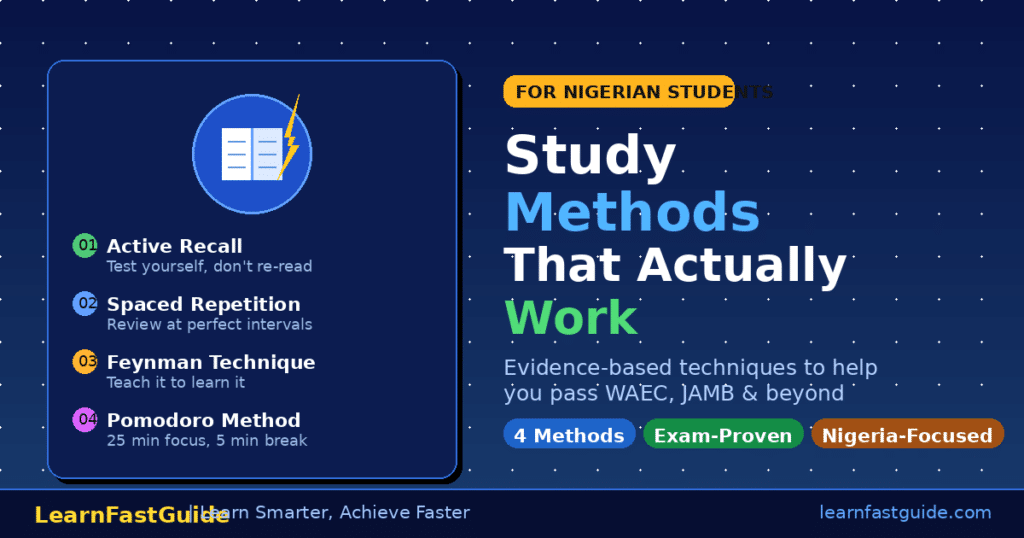
Active Recall — The Most Important Method You Are Probably Not Using
If you take nothing else from this guide, take this: the single most effective thing you can do to improve how much you retain from studying is to test yourself on the material instead of reading it again.
This is called active recall, and the evidence behind it is overwhelming. Study after study shows that students who retrieve information from memory — rather than reviewing it passively — retain significantly more of it over time. The act of trying to remember something, even when you struggle and get it wrong, strengthens the memory trace in a way that re-reading never does.
Here is what active recall looks like in practice for a Nigerian student:
You finish reading a section of your Chemistry textbook on electrolysis. You close the book. You take out a blank sheet of paper and write down everything you can remember about electrolysis — the definition, the process, the examples, the types of electrodes, the products at each electrode for different solutions. You do not look at the book while you do this. After you have written everything you can remember, you open the book and check what you missed or got wrong. Then you focus your next reading on exactly those gaps.
That process takes more effort than just reading again. That effort is precisely why it works. Your brain is forced to retrieve and reconstruct the information, which is the same cognitive process that happens in an exam. You are essentially practising the exam every time you study.
Practical ways to use active recall for Nigerian exam preparation:
For WAEC and JAMB, past questions are the most powerful active recall tool available to you. Do not use them at the end of your preparation as a final test. Use them throughout your preparation as the primary way you study. Attempt questions from a topic before you feel fully ready. The struggle of attempting questions you cannot fully answer yet accelerates learning faster than waiting until you feel confident.
For memorisation-heavy subjects like Government, History, Biology, and CRK — make flashcards. Write the question or term on one side and the answer or definition on the other. Test yourself with them regularly. The Anki app on your phone automates the timing of this so you review each card at the optimal moment before you forget it.
For Mathematics and Physics, active recall means doing problems without looking at examples. Many students study Maths by reading through solved examples, which feels like studying but is actually passive. The only way to know whether you can solve a type of problem is to attempt it without looking at the solution first.
Spaced Repetition — Why Cramming Produces Results That Disappear
The night before an exam, cramming can feel like it works. You cover a large amount of material in a short time, it is fresh in your mind the next morning, and you walk into the exam with a certain confidence. Then six days later, asked about the same material, you remember almost none of it.
This happens because cramming produces short-term retention, not long-term learning. Your brain treats information reviewed once as probably unimportant and does not invest in storing it permanently. Information that you return to repeatedly over time gets progressively moved into longer-term storage because repeated exposure signals to your brain that this information keeps coming up and therefore matters.
Spaced repetition is the practice of deliberately spreading your review of material across increasing intervals of time. The basic pattern looks like this:
Study a topic on Monday. Review the same topic briefly on Wednesday. Review it again the following Monday. Review it again two weeks after that. Each review takes less time than the one before because the material is more familiar, but each one strengthens the memory significantly.
For Nigerian students preparing for WAEC or JAMB across multiple subjects over months, this means starting your preparation early enough to allow spaced repetition to work. A student who starts serious preparation in January for May exams has time to review every major topic three or four times at spaced intervals. A student who starts in April is forced to cram, which produces a worse result for the same amount of total study hours.
The Anki app handles the spacing calculation automatically — it shows you each flashcard at exactly the interval when you are about to forget it. If you prefer a manual approach, keep a simple log of when you studied each topic and build review sessions into your weekly schedule specifically for previously covered material.
The Feynman Technique — Using Explanation to Expose What You Do Not Actually Understand
Richard Feynman was a Nobel Prize-winning physicist who became famous partly for his ability to explain extraordinarily complex ideas in simple language. His method for learning and for identifying gaps in understanding was straightforward: if you cannot explain something simply, you do not actually understand it yet.
The technique works like this. After studying a topic, close your notes and try to explain the concept out loud or in writing as if you are teaching it to someone who knows nothing about it. Use simple language. Avoid jargon. Work through examples from scratch.
At some point in that explanation, you will get stuck. You will reach a point where the explanation breaks down because your understanding breaks down. That sticking point is exactly the thing you need to go back and study more carefully.
This technique is particularly powerful for Nigerian students in subjects that require genuine understanding rather than memorisation — Mathematics, Physics, Chemistry, Economics. Many students in these subjects have memorised procedures without understanding why they work, which means they can solve familiar question types but fall apart when the same concept appears in an unfamiliar format. The Feynman technique forces you to build real understanding rather than just procedural memory.
Practical application: after studying any concept in a science or mathematics subject, take five minutes to explain it on paper as if you are writing to a younger student who has never seen it before. Work through an example from scratch. Wherever your explanation becomes vague or you have to write “and then somehow you get…” — that is where your understanding has a gap.
The Pomodoro Technique — A Simple Structure for Students Who Struggle With Focus
Sustained concentration is genuinely difficult, and for Nigerian students dealing with household noise, younger siblings, unpredictable light, and a phone full of WhatsApp messages, the challenge is even greater than average.
The Pomodoro technique is a simple time management structure that many students find helps them build focused study sessions without feeling overwhelmed. The structure is: study for twenty-five minutes with complete focus, then take a five-minute break. After four of these cycles, take a longer break of fifteen to thirty minutes.
The psychological principle behind it is that committing to twenty-five minutes feels manageable in a way that “I need to study for three hours” does not. Instead of dreading a long session, you are just doing one short block. Then another. Then another.
During each twenty-five minute block, the phone goes somewhere you cannot easily reach it. No notifications, no checking messages, no quick scroll. Just the work. The break is the reward and the reset — stand up, walk around, drink water, look at something other than your notes.
For Nigerian students dealing with irregular power supply: the Pomodoro structure also helps you make better use of the hours when you have electricity. Instead of drifting through those hours without structure, you have a defined system that produces focused output within whatever window you have available.
Practice Testing Under Exam Conditions
One of the most valuable things you can do in the weeks before WAEC or JAMB is sit down with past question papers and complete them under real exam conditions — timed, no notes, no phone, writing your answers as you would in the actual exam hall.
This matters for several reasons beyond just the content knowledge. First, it builds exam stamina — the ability to maintain concentration and performance over a full exam duration. Second, it exposes you to the specific style of questioning that WAEC and JAMB use, which has patterns and tendencies that become familiar through practice. Third, it reduces exam anxiety because you have already rehearsed the experience multiple times.
Many students use past questions incorrectly — they attempt a question, immediately check the answer if they are unsure, and move to the next one. This approach eliminates most of the learning benefit. The correct approach is to attempt the entire paper or section without checking answers, then mark it honestly at the end, then study specifically the questions you got wrong or guessed on.
For JAMB specifically: practice under CBT conditions. Use apps that simulate the computer-based format and set a timer. Students who struggle with JAMB often understand the content but are not accustomed to answering multiple-choice questions on a screen under strict time pressure. That is a separate skill from content knowledge and it needs to be practised separately.
Interleaving — Mixing Subjects Instead of Blocking Them
Most students study by blocking — spending an entire session or even an entire day on one subject before moving to the next. This feels organised and comfortable. It is also one of the less effective approaches to retention.
Research consistently shows that interleaving — mixing different subjects or different types of problems within a single study session — produces better long-term retention than blocking, even though it feels harder and less comfortable in the moment.
The reason is that switching between subjects forces your brain to constantly retrieve and reorient, which strengthens memory. When you study Mathematics for three straight hours, the later material builds on the pattern of the earlier material and your brain does not have to work as hard to retrieve and apply it. When you switch from Mathematics to Chemistry to English within a session, each switch requires genuine retrieval.
Practical application: instead of Monday being your Mathematics day and Tuesday being your Chemistry day, mix them within each session. Study Mathematics for forty-five minutes, then Chemistry for forty-five minutes, then return to Mathematics for another thirty minutes. It will feel less smooth, but the evidence strongly suggests it produces better results over time.
Environment and the Conditions That Support or Undermine Focus
Where and how you study affects how much you learn from the same amount of time, even if the method is identical.
Temperature matters — a hot, stuffy room degrades concentration. If you can study in a cooler part of your house or in the early morning before the heat builds, that is worth doing.
Noise matters — complete silence is not necessary and is not always achievable in Nigerian households, but sustained loud noise or music with lyrics competes directly with reading and writing tasks. Instrumental music or ambient sound is less disruptive than music with words if you need background sound.
Lighting matters — studying by poor torchlight for extended periods causes eye strain that compounds fatigue. If your primary study hours coincide with power outage hours, a rechargeable lamp is a genuine investment in your academic performance.
Posture matters more than students typically acknowledge — studying while lying on your bed consistently leads to lower alertness and higher likelihood of falling asleep. Sit upright at a table or desk for serious study sessions.
Sleep is not optional — your brain consolidates and permanently stores what you studied during slow-wave sleep. Students who sacrifice sleep to gain more study hours consistently perform worse than those who study fewer hours and sleep adequately, because the learning from those hours never fully consolidates without the sleep to follow it. If you are choosing between two more hours of studying at 1am or sleeping, sleeping is almost always the better choice for your exam performance.
Putting It Together — A Method Stack for Nigerian Students
No single technique is sufficient on its own. The students who learn most effectively tend to combine methods in a system that covers the different aspects of learning.
A practical combination for WAEC and JAMB preparation:
Use active recall as your primary study method — close the book and retrieve before you reread.
Use past questions throughout preparation, not just at the end — attempt questions on each topic as you cover it.
Use spaced repetition for review — build a weekly review session into your schedule covering previously studied material.
Use the Feynman technique after every new concept in science and mathematics subjects — explain it simply to identify gaps.
Use the Pomodoro structure to manage your focus during sessions, especially when motivation is low.
Practice full past papers under timed conditions at least once per week in the final two months before exams.
The students who struggle most are not usually the least intelligent. They are the ones who spent the most hours in the least effective ways — reading and re-reading, highlighting without testing, covering familiar material because it feels comfortable while avoiding the topics that actually need attention.
Change the method and the results change.
Frequently Asked Questions
Which study method is best for WAEC preparation? Active recall through past questions is the single most effective method for WAEC preparation. Attempt questions on each topic as you cover it, mark your answers honestly, and study specifically what you got wrong. Combine this with spaced repetition — reviewing previously covered topics at regular intervals — and you have the foundation of a strong preparation approach.
How do I study when I cannot concentrate? Start with the Pomodoro technique and commit to just one twenty-five minute session. Remove your phone from reach before you start. Often the hardest part is beginning — once you are five minutes into a focused session, continuing becomes easier. If concentration genuinely fails after multiple attempts, consider whether fatigue, hunger, or stress is the underlying issue and address that first.
Is reading through notes enough to pass WAEC or JAMB? Reading through notes is useful as an initial exposure to material but it is insufficient on its own for exam preparation. What determines your exam performance is how well you can retrieve and apply information under exam conditions, and that requires practice through active recall and past questions — not just passive reading. Students who rely primarily on reading often know the material but cannot perform under exam pressure because they have never practised that specific skill.
How many hours should I study per day for WAEC or JAMB? Three to five hours of genuinely focused studying using effective methods will produce better results than eight hours of passive reading with frequent distractions. Build up to your target daily hours gradually, prioritise the quality of each session over the total duration, and ensure you are sleeping adequately so the learning from each session actually consolidates.