Working from home in a small space is a problem of competing pressures: you need a functional workspace, but you don’t have a dedicated room for one. You need to look professional on video calls, but your living room or bedroom is doing three jobs at once. You need storage, but every square foot is already spoken for.
This guide covers twelve home office setups specifically designed for small spaces — apartments, studio flats, shared houses, and rooms where the desk competes with everything else for floor space. Each setup includes a budget breakdown across three tiers:
- Tight budget — making it work with the minimum
- Mid-range — comfortable functionality without overspending
- Invested — a setup you’ll genuinely want to sit at for eight hours
Everything here prioritizes space efficiency first, aesthetics second, and cost honestly throughout.
Before You Set Up: 3 Rules for Small Space Home Office
Three principles separate small-space setups that work from ones that feel cramped and chaotic regardless of how much you spend:
1. Vertical space is free real estate. Most people set up a desk, put things on it, and run out of horizontal surface immediately. Walls are almost always underused. Shelving, pegboards, monitor arms, and wall-mounted cable management turn vertical space into functional workspace without consuming a single square foot of floor area.
2. Cable management is not optional. In a small space, visual clutter feels physically suffocating in a way it doesn’t in a large room. A clean desk with hidden cables reads as organized and spacious; the same desk with visible cable chaos reads as cramped even if the furniture is identical.
3. Lighting matters more than most people expect. A dark corner setup feels smaller and more oppressive than the same setup near a window or with a good desk lamp. Natural light is free; positioning your setup to take advantage of it costs nothing and changes everything about how the space feels.
The 12 Small Space Home Office Setups
1. The Wall-Mounted Fold-Down Desk
A fold-down desk (also called a murphy desk or wall desk) mounts flush against the wall and folds out when needed, then disappears completely when you’re done — leaving the floor space entirely free. This is the single most space-efficient desk option available and ideal for studio flats and multipurpose rooms where you need the floor back in the evenings.
How to implement: Mount the fold-down unit at a comfortable working height (usually around 74–76cm from floor to desk surface). Pair with a wall-mounted shelf above for monitor placement or storage. Use a laptop stand or monitor arm to keep your screen at eye level. A lightweight chair that tucks away cleanly — a barstool-height stool or a folding chair — completes the setup.
| Budget Tier | What You Get | Estimated Cost |
|---|---|---|
| Tight | IKEA NORBERG fold-down desk, self-installed, clip-on LED lamp | $50–$150 |
| Mid-range | Better fold-down unit with integrated shelving, monitor arm, LED task light | $200–$500 |
| Invested | Custom or designer murphy desk system (Resource Furniture, Clei) with integrated cable management | $600–$1,200+ |
2. The Corner Desk Setup
Corner desks use the one space in a room that is almost universally underutilized — the corner. An L-shaped or triangular corner desk gives you significantly more surface area than a straight desk of similar depth while consuming a footprint that was otherwise dead space.
How to implement: Measure your corner carefully before buying — corner desks vary widely in arm lengths and the angle between them. Position your monitor in the corner where the two arms meet (the deepest point) to keep it at arm’s length. Use the two arms for different activities — primary screen on one side, notebooks or a second monitor on the other.
| Budget Tier | What You Get | Estimated Cost |
|---|---|---|
| Tight | IKEA MICKE or LINNMON corner combination — two desks arranged in an L | $80–$200 |
| Mid-range | Proper L-shaped desk with steel frame, cable management holes (Flexispot, Uplift budget lines) | $250–$600 |
| Invested | Sit-stand L-shaped corner desk with dual-motor height adjustment | $700–$2,000+ |
3. The Closet Conversion (Cloffice)
Converting a wardrobe or closet into a dedicated home office — commonly called a “cloffice” — turns dead storage space into a fully contained work zone that closes away completely when work is done. Ideal for shared living spaces where you want a clear psychological separation between work and home.
How to implement: Remove hanging rails and install a floating desk surface at working height. Add shelving above for storage and equipment. Run power from the nearest outlet. Add battery-powered or plug-in LED strip lighting inside the closet — built-in closet lighting is rarely at desk level.
| Budget Tier | What You Get | Estimated Cost |
|---|---|---|
| Tight | IKEA KALLAX or ALEX as desk base, wooden board as desktop, peel-and-stick LED strips | $100–$300 |
| Mid-range | Floating shelf desk (IKEA EKBACKEN countertop), monitor arm, integrated power strip, better lighting | $400–$800 |
| Invested | Custom millwork to exact closet dimensions, integrated cable management, task lighting, concealing door | $1,000–$2,500 |
4. The Floating Shelf Des
A wide, deep shelf mounted at desk height functions as a desk surface with nothing beneath it — no legs, no pedestal — leaving the floor space completely free. Works particularly well in narrow rooms where even a slim desk feels obstructive.
How to implement: Mount a shelf at least 50–60cm deep. Use heavy-duty floating shelf brackets rated for significantly more than your expected load — a monitor, laptop, and accessories add up fast. Manage cabling against the wall behind the shelf using adhesive cable clips.
| Budget Tier | What You Get | Estimated Cost |
|---|---|---|
| Tight | IKEA LACK or EKBY shelf system used as a desk surface — best for laptop-only setups | $40–$120 |
| Mid-range | Butcher block or solid wood shelf on heavy-duty floating brackets | $150–$400 |
| Invested | Custom fabricated wood, stone, or glass surface with integrated cable management channels and wall-mounted power | $500–$1,500 |
5. The Under-Stair Setup
The space beneath a staircase is often completely wasted or used for random storage. Converted thoughtfully, it becomes a naturally contained home office alcove with its own ceiling line and defined boundaries.
How to implement: Measure the usable sitting height — you need at least 120cm clear above your chair seat position. Build or install a desk surface at working height, add shelving along the back and side walls, and run power from the nearest source.
| Budget Tier | What You Get | Estimated Cost |
|---|---|---|
| Tight | Flat-pack desk cut to fit, freestanding shelving along the back wall | $150–$400 |
| Mid-range | Custom-built desk and shelving fitted to the exact stair shape, painted to match interior | $500–$1,200 |
| Invested | Full custom carpentry with built-in storage, integrated lighting, cable management, optional concealing door | $1,500–$4,000+ |
6. The Bedroom Desk Nook
Most people with small homes eventually put a desk in their bedroom. Done poorly, it creates a space that never fully switches off. Done well, it is genuinely functional and psychologically manageable.
How to implement: Position the desk so it is not in your direct sightline from your bed — ideally in a corner at 90 degrees to your sleep position. Use a room divider, bookshelf, or curtain panel to create visual separation. Keep the desk surface clear at the end of each workday as a psychological off-switch ritual.
| Budget Tier | What You Get | Estimated Cost |
|---|---|---|
| Tight | Slim desk (60cm depth), clip-on monitor light that doesn’t spread ambient light into the sleep zone | $80–$200 |
| Mid-range | Desk with drawer storage, monitor arm, privacy curtain or half-height bookshelf as room divider | $250–$600 |
| Invested | Built-in desk and shelving in an alcove with roller blind or curtain system to conceal setup completely | $700–$1,500 |
7. The Window Desk Setup
Positioning your desk in front of or beside a window is one of the simplest, cheapest improvements available to any small-space home office. Natural light improves mood, reduces eye strain, and makes a small space feel significantly larger than it is.
How to implement: Face the window if video calls aren’t a primary concern — natural front-lighting looks good on camera. Face away from the window if you’re frequently on calls and prefer the light behind you illuminating your face, but add a desk lamp for non-daylight hours. Use a slim desk that doesn’t block the window or reduce light into the room.
| Budget Tier | What You Get | Estimated Cost |
|---|---|---|
| Tight | Any narrow desk positioned at a window, plus a basic blind for glare control | $60–$180 |
| Mid-range | Floating windowsill desk — a shelf surface built across a wide windowsill, using its depth as the desk | $250–$500 |
| Invested | Custom built-in desk running along the full width of a window wall with storage above and below the opening | $600–$1,500 |
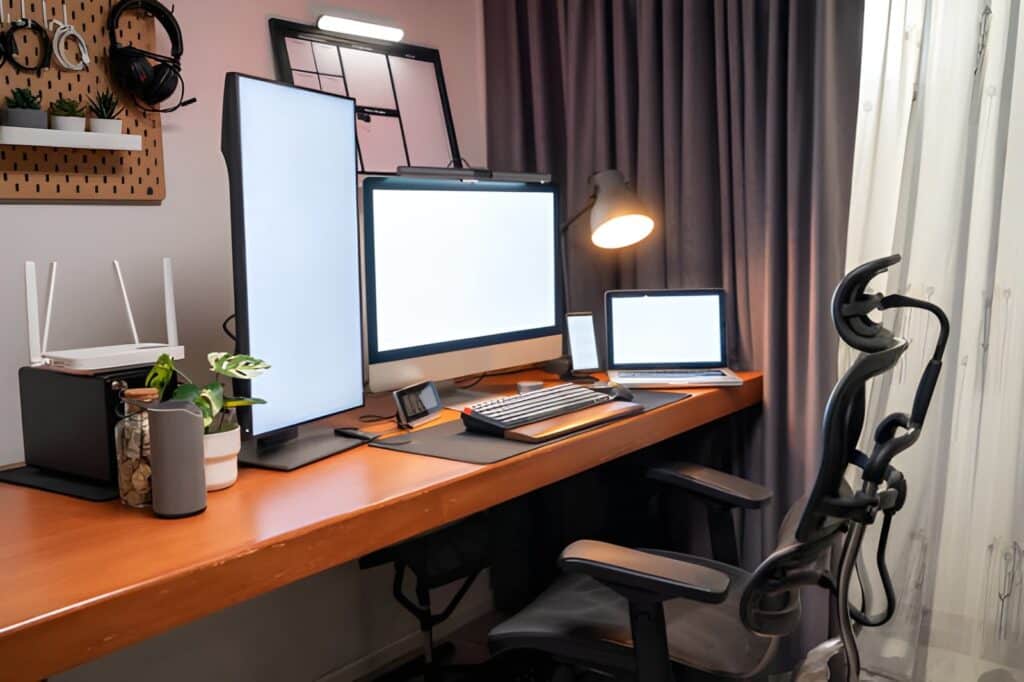
8. The Pegboard + Slim Desk Combination
A pegboard mounted above a slim desk keeps the desk surface permanently clear — because everything (cables, headphones, small shelves, notebooks, tools) lives on the pegboard wall instead of on the desk.
How to implement: Mount a pegboard (IKEA SKÅDIS is the most widely used option) at a size that covers most of the wall above your desk. Add hooks, small shelves, and cable clips to the board. Wall-mount your monitor separately from the pegboard if possible. The result is a desk surface that stays genuinely clear because its storage function has moved vertical.
| Budget Tier | What You Get | Estimated Cost |
|---|---|---|
| Tight | IKEA SKÅDIS pegboard + IKEA LINNMON desk — one of the most reliable small-space combos available | $40–$150 |
| Mid-range | Higher-quality desk paired with a custom-cut wooden or metal pegboard, more refined accessories | $200–$500 |
| Invested | Wall-mounted custom storage system (e.g. String Furniture wall systems) combining shelving, pegboard function, and fixed or folding desk in one unit | $600–$1,200 |
9. The Standing Desk + No Chair Setup
Removing a chair entirely — replacing it with a standing desk and an anti-fatigue mat — reclaims the 60–80cm of floor depth a chair requires when pushed back. Not suitable for full-time standing work, but effective as a secondary desk or for people who naturally prefer to stand.
How to implement: Set the desk surface at elbow height when standing (roughly 95–110cm for most adults). Add an anti-fatigue mat. Keep a bar stool nearby for leaning breaks rather than full sitting.
| Budget Tier | What You Get | Estimated Cost |
|---|---|---|
| Tight | Fixed-height standing desk at standard standing height — significantly cheaper than sit-stand models | $100–$300 |
| Mid-range | Single-motor sit-stand desk for occasional height adjustment with a stool | $400–$900 |
| Invested | Dual-motor sit-stand desk with memory presets, quiet adjustment, and a large working surface | $1,000–$2,500 |
10. The Shared Space Dual-Purpose Set
For rooms that serve as both living space and office — common in studio apartments — the goal is a setup that looks like home decor when work is done, not like an office that never left.
How to implement: Choose desk furniture in warm materials (wood tones, rattan, natural finishes) rather than black metal office aesthetics. Use decorative boxes and baskets as storage instead of utilitarian desk organizers. Position a desk lamp that doubles as ambient room lighting. Keep monitors on swing arms so they can be tucked away or angled out of view during non-work hours.
| Budget Tier | What You Get | Estimated Cost |
|---|---|---|
| Tight | Secondhand or flat-pack wooden desk styled with plants, a nice lamp, and decorative storage to blend into the room | $100–$300 |
| Mid-range | Purpose-designed “desk as furniture” piece from West Elm, Article, or similar — desks designed to function as room furniture | $400–$900 |
| Invested | Custom joinery that looks like a built-in shelving unit or sideboard concealing a fold-out desk — the ultimate dual-purpose solution | $1,000–$3,000 |
11. The Minimal Laptop Setup
For work that genuinely only requires a laptop, a monitor, and a keyboard, the most space-efficient setup is also the simplest: a minimal desk, a laptop stand or single monitor arm, and a wireless keyboard and mouse to eliminate cable tangle.
How to implement: Elevate the laptop with a stand to bring the screen to eye level — this also dramatically improves posture. Add a Bluetooth keyboard and mouse. Optional: a single external monitor on an arm for dual-screen work without consuming surface space.
| Budget Tier | What You Get | Estimated Cost |
|---|---|---|
| Tight | Laptop stand ($20–$40) + basic Bluetooth keyboard and mouse combo ($30–$70) — transformative for under $100 | $40–$150 |
| Mid-range | Better laptop stand, mechanical or premium keyboard, single monitor arm for an external screen | $200–$500 |
| Invested | Ultra-slim desk, premium laptop stand (Twelve South, Rain Design), compact mechanical keyboard, single ultrawide monitor on an arm | $600–$1,500 |
12. The Alcove Setup
Alcoves — recessed wall sections beside chimneys, under bay windows, or built into the architecture — are naturally defined workspaces: contained on three sides, with a clear boundary separating them from the rest of the room. They are among the best small-space opportunities in any home.
How to implement: Fit a desk surface across the full width of the alcove at working height. Add shelving above to the ceiling, using every vertical inch of the recess. This creates a workspace that feels intentional and separated from the main room without consuming any additional floor space.
| Budget Tier | What You Get | Estimated Cost |
|---|---|---|
| Tight | Worktop cut to alcove width, resting on freestanding drawer units or shelf brackets | $80–$250 |
| Mid-range | Floating desk surface fitted to alcove width, custom-cut shelving above, painted to match walls for a built-in look | $300–$800 |
| Invested | Full carpentry with integrated lighting, cable management, and floor-to-ceiling storage around a built-in desk surface | $1,000–$3,50 |
For Renters: What to Prioritize When You Can’t Make Permanent Changes
Most of the setups above have a renter-friendly version. The key constraints to work around:
Wall mounting without damage is possible using heavy-duty removable adhesive systems (3M Command strips for lighter items, specialist adhesive anchors for heavier shelving) — though weight limits prevent very heavy monitor arms or loaded shelving. For heavier items, tension rod systems, freestanding shelf units pressed against the wall, and furniture-mounted solutions avoid wall damage entirely.
Best renter-friendly options from this list:
- The fold-down desk (minimal wall impact)
- The pegboard-and-desk combination (SKÅDIS mounts with a few screws, easily patched)
- The minimal laptop setup (no wall mounting needed)
- The shared-space dual-purpose setup (furniture only, no wall modification)
For Nigerian and West African Homes: What Changes Locally
Small-space home office setups in Nigerian homes face specific constraints that shape which options work best.
Power instability is the foundation problem. Any serious home office in Nigeria needs an inverter, a UPS (uninterruptible power supply), or solar backup as the first priority — not an optional extra. A beautifully organized desk that goes dark every time NEPA takes light is not a functional workspace. Budget for reliable power before spending on desk furniture.
Heat management matters more than in temperate climates. A setup pressed into a corner with no airflow creates significant discomfort during Lagos or Abuja’s peak heat months. Where possible, position desk setups near a window that can be opened, or within reach of a ceiling fan or AC unit. Dark desk surfaces and enclosed setups retain more heat than open, lighter-coloured ones.
Custom carpentry is often the best value option locally. Furniture sourcing at mid-range price points is more limited than the international options listed above, but Lagos markets (Ikeja, Trade Fair) and platforms like Jiji carry a wide range of desk options. A local carpenter who can build exactly what you need for your alcove, closet, or under-stair space is often more affordable and more precise than any imported flat-pack alternative.
Final Word
A small-space home office doesn’t require a large budget or a dedicated room. It requires choosing the right setup for your specific constraints — your floor plan, your furniture situation, whether you rent or own, and how many hours a day you actually need to work there.
Start with the two free wins — natural light positioning and cable management — before spending anything. The difference those two changes make to how a workspace feels and functions is disproportionate to their cost, which in both cases is zero.